Guides · 4 August 2026
Long-term upright piano storage: what you need to know
An upright stored for a few weeks while a house sale completes is a straightforward booking. An upright stored for a year or more because life has changed in a bigger way, a child has left home, a room is being let out, an estate is being settled, or a move to a smaller property means there is simply no space for it, is a different kind of arrangement. The instrument is the same, but the time horizon changes what you need to know before you book, what happens in the facility, and what the piano will need when it comes back to you.
What time does to a piano in the wrong conditions
The risks an upright faces in a poor storage environment do not announce themselves quickly. A piano that sits in a damp garage or an unheated spare room for two weeks will look and feel much the same as when it went in. A piano that sits in those same conditions for six months or a year will not.
Humidity variation is the main agent of deterioration over a long period. The soundboard of an upright sits vertically inside the case, protected on the back by the rear panel but exposed to air movement through the cabinet joints. Repeated cycles of swelling in a damp summer and drying out under central heating in winter cause the soundboard to move against the bridges, shift the glued joints, and eventually affect tuning stability in ways that cannot be reversed quickly. The pinblock, which is the dense laminated hardwood that grips the tuning pins, shrinks in sustained dry conditions and loses that grip. The action, which is the mechanical system of hammers, leathers and felt behind the keys, is the part that tends to show the effects of a poor environment first: leathers harden, felt compresses unevenly, and the wooden parts carry every humidity swing they experience.
None of this is dramatic. It is cumulative. By the time it shows, it is expensive to reverse, and some of it cannot be reversed at all. Preservation over a long period comes down to one thing: holding the environment steady.
Why climate control is the whole basis of a long-term decision
For a stay measured in weeks, a climate-controlled facility is the right choice but not an absolute necessity for every instrument. For a stay measured in months or years, it is not optional. A UK year carries two distinct threats for an unprotected piano. Summer brings warm, often humid air that pushes moisture into the wood. Winter brings central heating that pulls it back out, often sharply. An upright held through that annual cycle without controlled conditions will be a different instrument by the time it returns.
A specialist climate-controlled facility holds temperature and humidity at instrument-safe levels throughout the year. There is no seasonal drift, no damp August, no dry January. The soundboard, the pinblock and the action all stay in the same stable environment from the day the piano arrives to the day it leaves.
- Temperature and humidity controlled throughout the year, not subject to seasonal swings
- No cycles of damp and dryness that cause wood to swell, contract and loosen
- The same consistent conditions in August as in January
- Protection for the action, soundboard, bridges and pinblock across the full period of storage
How an upright is handled and stored
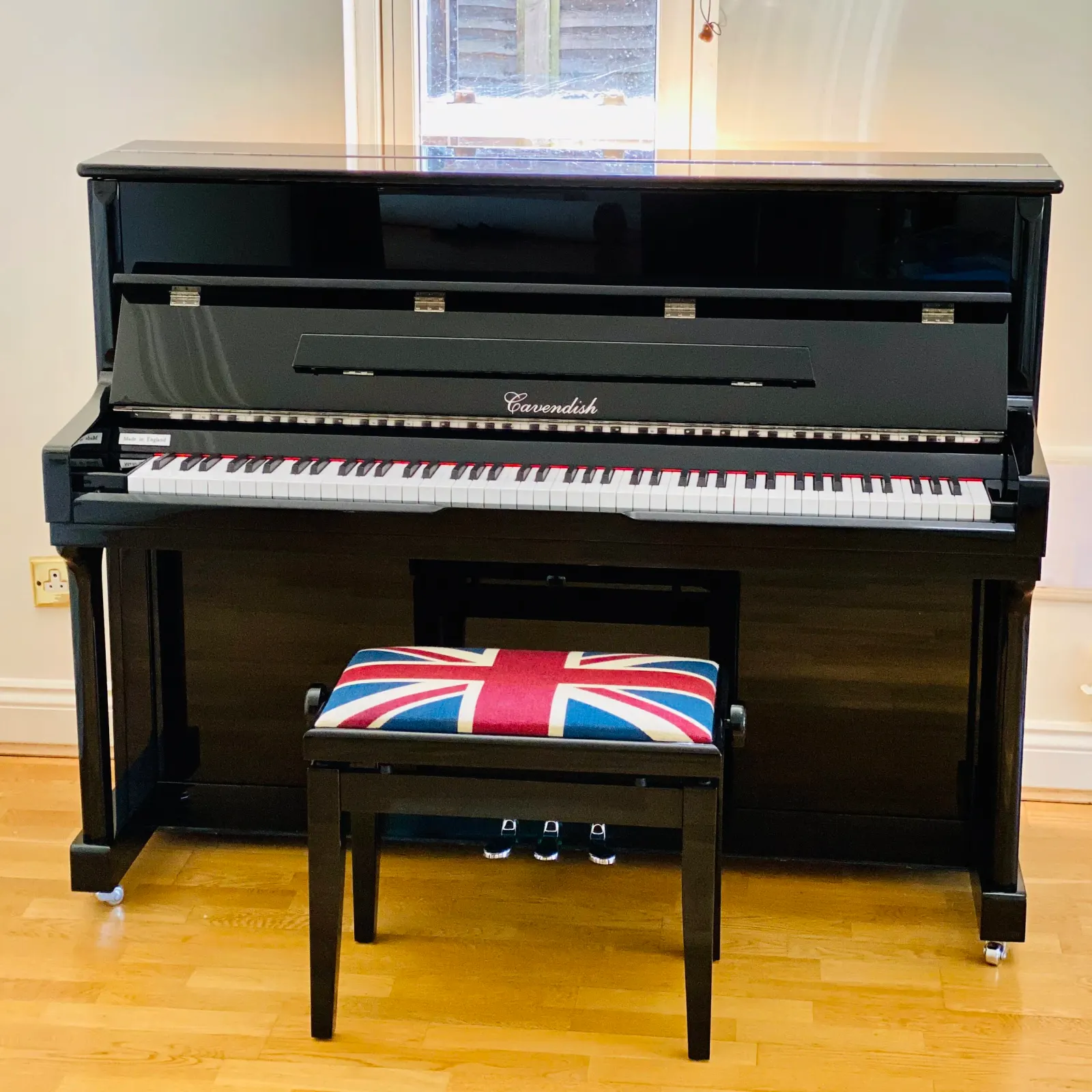
An upright piano is collected by a specialist piano crew and wrapped in fitted transit covers before it is moved. Unlike a grand, which is dismantled before collection, an upright travels and is stored in the same upright orientation it stands in at home. The strings run vertically, the action sits against the front face, and that position is maintained in the facility for the duration of the stay. Nothing is placed on top of the instrument or leant against it.
The music desk may be removed and wrapped separately if it is loose or unusually large. The key cover and the pedal area are padded and protected throughout. The body of the instrument is not dismantled, and the crew does not open the instrument unless there is a specific reason agreed at booking.
If the piano is on an upper floor, stair access is priced clearly in the booking confirmation before the crew arrives. There are no figures added on the day. Tight doorways, low ceilings and properties without a lift are all manageable with the right preparation and crew. What matters is that the access details are accurate when you book, so the right people and the right equipment are sent.
- Specialist piano crew, not a general removal team, handles collection and re-delivery
- Fitted transit covers protect the casework throughout
- The piano remains upright in the facility throughout, in its natural orientation
- Stair access without a lift is priced clearly in the booking, not added on collection day
How billing works for an open-ended stay
When you store through the Pianospeed Group, there is no requirement to commit to a fixed end date. The collection fee and the first four weeks are settled at booking. After that, a weekly rate continues on a rolling four-weekly billing cycle for as long as the piano stays. The piano is held on full insurance in a secure facility from the moment of collection through to re-delivery, so there is no separate cover to arrange or renew during the period.
When you are ready for the piano to come back, you contact us and arrange re-delivery to whichever address you need. That might be the same property, a different home, or a relative's address. There is no penalty for an earlier return than expected.
What the piano needs when it comes home
Re-delivery is handled by the same specialist crew that collected. The piano is carried into its room, positioned and levelled, and the crew checks it is stable before leaving. Once it is in place, the piano needs time to settle in the new room before any other work is done. Wood and strings adjust to the temperature and humidity of the new environment, and that adjustment takes a few weeks. A tuner who comes too soon after re-delivery is working on an instrument that is still moving.
For a piano that has been away for six months or more, the usual recommendation is to allow two to three weeks of settling time before the tuner arrives, and to plan for two tuning visits rather than one. The first brings the pitch back. The second, a few weeks later, stabilises the strings under that new tension. A good piano tuner will hear the instrument on the first visit and advise you directly. For a shorter stay, a single tuning once the piano has settled is usually enough.
How long counts as long-term storage for an upright piano?
There is no fixed threshold, but most people use specialist storage as long-term when the piano will be away for more than three months. Below that, the same service runs on a shorter billing cycle. The environmental risks that make specialist storage important are real from the first day, but they accumulate most meaningfully over months rather than weeks. For any stay where you cannot confidently say the room will stay heated and humidity-managed, specialist storage is the right choice regardless of the duration.
Will my upright deteriorate in specialist climate-controlled storage?
No. The whole point of a climate-controlled facility is to hold conditions steady so that the deterioration that happens in unmanaged spaces does not occur. Temperature and humidity are maintained at instrument-safe levels throughout the year, the piano is held upright in its natural orientation, and nothing is placed on it. An upright that goes in correctly wrapped and handled will come out in the same condition.
Does an upright need to be dismantled for long-term storage?
No. An upright is stored in one piece, in the same upright orientation it stands in at home. The strings run vertically, the action is supported in its normal position, and no structural dismantling is required. The music desk may be removed if it is loose, and the key cover and pedal area are padded, but the body of the instrument stays intact throughout, however long the stay.
How many tunings will my upright need when it comes back from a long stay?
At least one, and for stays of six months or more, plan for two. The first tuning brings the pitch back after the journey and the change of environment. The second, a few weeks later, stabilises the strings under that new tension. Give the piano two to three weeks to settle in its room before the tuner comes: the wood and strings adjust to the room's conditions first, and the tuning holds better as a result.
Do I need to commit to an end date when I book long-term storage?
No. There is no fixed term. You pay for the collection and the first four weeks at booking, then a weekly rate billed in four-week cycles for as long as the piano stays. When you are ready for it back, you arrange re-delivery. There is no penalty for an earlier return than expected and no minimum period beyond the initial four weeks.
What if the piano is on an upper floor with no lift?
Stair access is handled by the specialist piano crew and priced clearly in the booking before the crew arrives. Tell us the floor the piano is on, whether there is a lift, and any tight doorways or awkward access at the property. Those details determine the crew size and any additional stair charge. Nothing is added as a surprise on the day of collection.
Store your piano the right way
We collect, protect and re-deliver. You only pay for the time you use.
Get an instant price★★★★★ Rated 4.9 out of 5 on Trustpilot from 77 reviews