Guides · 15 September 2026
Storing a Bosendorfer or Fazioli Grand | PianoStorage
Owners of Bosendorfer and Fazioli grands rarely need convincing that standard storage is not adequate. They already know it. What they need to know is whether a specialist company actually understands their specific instrument, or whether specialist piano storage means the same thing regardless of what the piano is. It does not, and this page explains the differences that matter.
The Bosendorfer resonance case
Most grands, including Steinways, are built around a structural rim that is acoustically separate from the soundboard. The soundboard sits within that rim and does the acoustic work. A Bosendorfer is built differently. The cabinet walls, including the exposed inner spruce sides of the case, are structural parts of the resonating body. The case itself contributes directly to the instrument's tone.
This construction, known as the resonance case, gives a Bosendorfer its characteristic warmth and sustain in the lower registers. It also means that the full cabinet structure responds to climate changes during storage. The exposed spruce inner walls are not insulated from humidity variation the way a heavily lacquered rim on another instrument might be. A sustained period outside the correct humidity range affects more of the instrument's acoustic architecture, not just the soundboard.
- The resonance case construction makes the full cabinet climate-sensitive, not just the soundboard alone
- Inner spruce walls require the same stable humidity as the soundboard
- Extended range models including the 97-key Imperial carry additional bass strings whose bridge and pin area also respond to humidity cycling
- The tonal character a Bosendorfer is known for is partly a product of that construction, and that construction is what storage conditions affect
The Fazioli soundboard: where it comes from and why it matters
Fazioli, founded in 1978 and based in northeast Italy, produces fewer than two hundred instruments a year. The soundboard on each instrument is made from spruce grown in the Val di Fiemme valley, a forest whose timber has supplied instrument makers for centuries. The grain regularity and resonance density of this wood is selected to a standard that cannot be substituted from general commercial sources.
That material specificity matters in storage. A Val di Fiemme spruce soundboard has been selected, aged and fitted to tolerances matched to the rest of the instrument. Humidity cycling, the repeated expansion and contraction that happens when a piano is held in an uncontrolled environment through a British winter and then a warm spring, stresses those tolerances cumulatively. A Fazioli soundboard repair requires craft and material that sits almost entirely within Fazioli's own workshop in Italy. The path is long and the cost reflects that. The practical answer is to store the instrument correctly so the question of repair does not arise.
Climate: what both instruments need
The standard target for both instruments is 45 to 55 percent relative humidity and a temperature range of 15 to 21 degrees Celsius. The requirement for stability is at least as important as the target range itself. A facility that averages correctly but fluctuates significantly through the seasons does not meet the standard a Bosendorfer or Fazioli requires.
The climate-controlled facility PianoStorage uses holds conditions within a narrow band throughout the year, monitored continuously. There is no seasonal drift, no overnight temperature drop when heating reduces, and no summer spike in an unventilated space. The instrument that arrives in September at 50 percent relative humidity is held in the same conditions in December and in the following March. A standard self-storage unit cannot provide this, and for these instruments the consequences of inadequate conditions are not easily reversed.
Collection, handling and what to tell us when you book
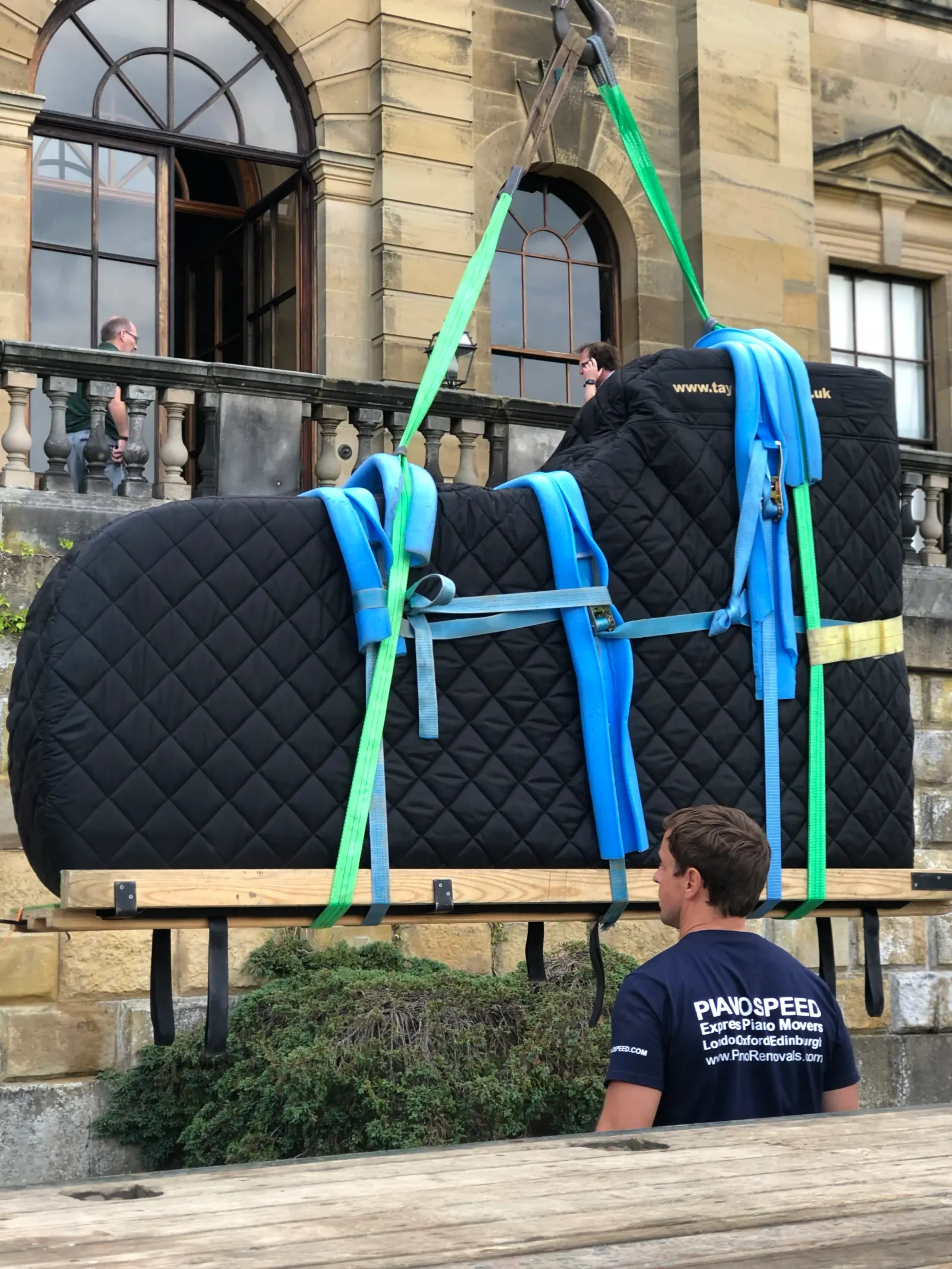
Any grand piano, including a Bosendorfer or Fazioli, goes into storage on its side with the legs removed. The lyre assembly, lid and music desk are removed at the property before loading, wrapped individually and stored alongside the body. For instruments where the cabinet itself is a structural acoustic component, as it is in a Bosendorfer, correct positioning matters more rather than less. Leaving a grand on its legs for months puts sustained load on the leg-to-cabinet joints, and that is before any consideration of the resonance case.
When you book, give us the floor the instrument is on, whether there is a lift, and any access detail relevant to the collection. Stair access is priced clearly in the booking and confirmed before you proceed, so the full cost is agreed in advance and nothing is added on the day. PianoStorage is part of the Pianospeed Group, which has handled concert instruments for institutions, musicians and private owners throughout GB mainland and Belfast.
- Legs, lyre assembly, lid and music desk removed and wrapped at the property before loading
- Body positioned on its side on a padded board with fitted transit covers in place from preparation onwards
- Access details including stairs taken at booking and priced clearly before the crew arrives
- Insurance cover from collection to re-delivery, alignable to a specialist valuation
- Specialist piano crews trained on concert grands of every type, size and age
Does a Bosendorfer need different storage conditions from other concert grands?
The target humidity and temperature range is the same: 45 to 55 percent relative humidity, 15 to 21 degrees Celsius, held stably. What is different about a Bosendorfer is the resonance case construction. Where a Steinway's acoustic work is concentrated in the soundboard, a Bosendorfer's inner cabinet walls also contribute to the instrument's tone. This means a larger proportion of the acoustic structure is directly exposed to climate conditions during storage, which makes consistent conditions more significant rather than less.
What is the extended range on a Bosendorfer Imperial, and does it affect storage?
The Bosendorfer Imperial, the 290 model, has 97 keys instead of the standard 88, adding nine bass notes below the lowest note on a normal keyboard. In storage terms the practical considerations are size and weight: the Imperial is longer and heavier than other Bosendorfer grands, and the additional bass strings and bridge area extend the instrument's climate requirements across a greater string length. The storage process is the same, but access and handling logistics should reflect the instrument's actual dimensions, which you should confirm when booking.
Fazioli pianos are extremely rare. Will your crew know how to handle one?
Specialist piano crews handle the same collection and positioning process regardless of manufacturer. The procedure, legs removed, body on its side on a padded board, fitted transit covers from the moment preparation begins, components wrapped individually, is correct for any concert grand and applies to a Fazioli as to any other. The instrument's rarity does not require a different procedure; it requires a crew that follows the correct procedure without improvisation, which is what specialist crews do.
How does insurance work for a Bosendorfer or Fazioli in storage?
When you book, provide the instrument's make, model, serial number and a specialist valuation if you have one. Cover during storage can be aligned to your recorded valuation. Without a specialist valuation on file, cover defaults to standard limits that are unlikely to reflect what a Bosendorfer or Fazioli is worth. A valuation from a registered piano valuer should be arranged before collection, and the reference logged with your account at booking. Home insurance is worth checking carefully: most policies cover instruments at the insured address only, and off-site storage may be excluded or capped.
Can a Bosendorfer or Fazioli grand be left on its legs for long-term storage?
No. Any grand piano should be positioned on its side with the legs removed for any storage period beyond a few days. Leaving a grand on its legs puts sustained load on the leg-to-cabinet joints over months. For a Bosendorfer, where the cabinet structure is itself an acoustic component, this matters more rather than less. The specialist piano crew removes the legs, lyre assembly, lid and music desk at your property before loading.
What does the piano need when it comes back from storage?
A piano returned from properly maintained climate-controlled storage should come back in the condition it went in. Pitch drift during the journey and while the instrument settles in a new room is normal, so plan a tuning two to three weeks after re-delivery rather than immediately. For a Bosendorfer or Fazioli that has been in storage for more than a year, two tunings a few weeks apart help the strings stabilise fully under tension. Voicing and regulation are standard service interval items and can follow at any point with your regular piano technician.
Store your piano the right way
We collect, protect and re-deliver. You only pay for the time you use.
Get an instant price★★★★★ Rated 4.9 out of 5 on Trustpilot from 77 reviews