Guides · 8 October 2026
Piano Storage for Property Developers | PianoStorage
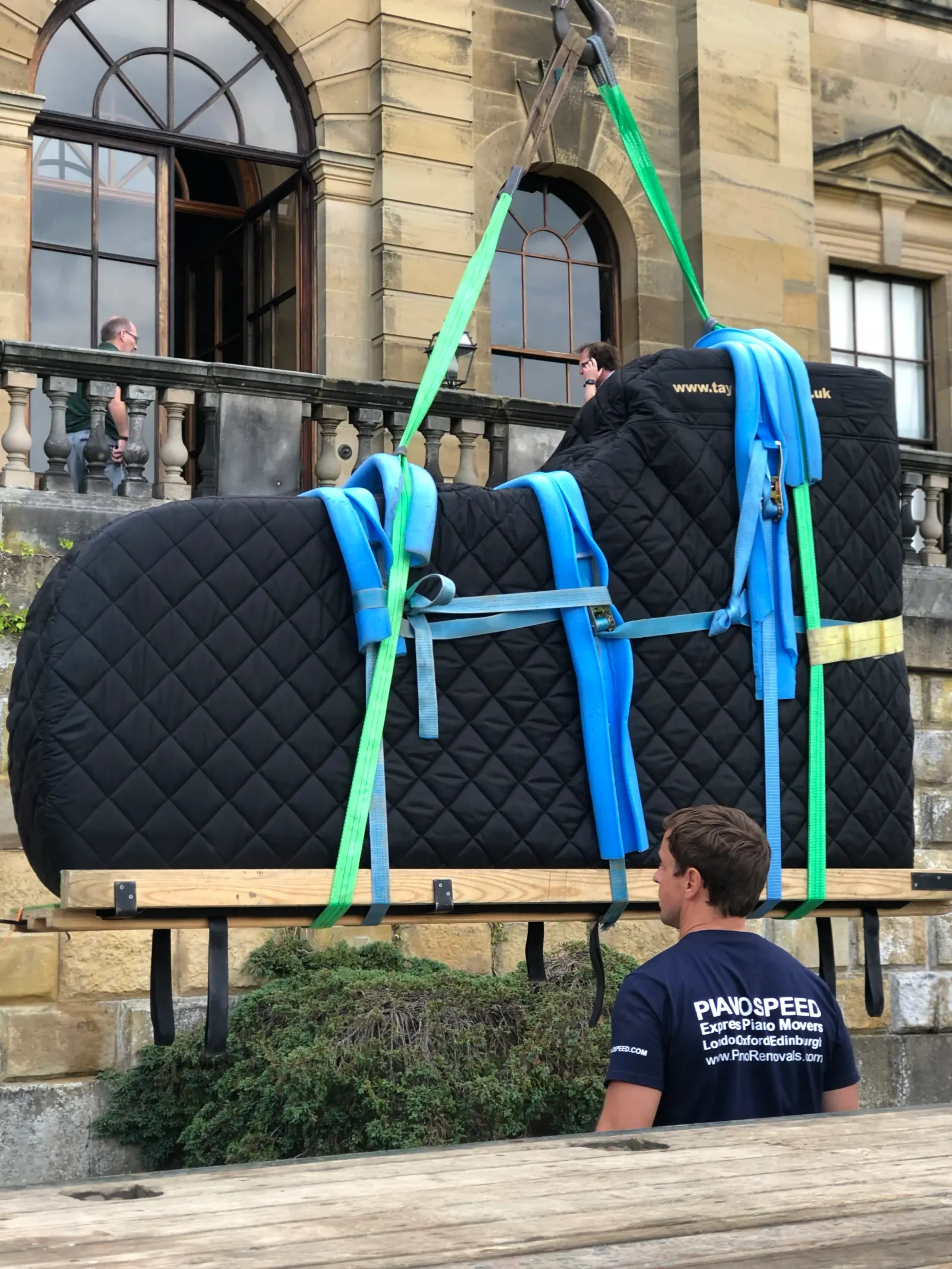
Property developers acquire buildings with contents. A period terrace in the Midlands. A Victorian school sold for residential conversion. A country house being split into apartments. An old hotel with a dining room grand. In each case the legal transaction transfers ownership of the structure, but what is inside does not always resolve itself at the same time. Pianos are among the items most likely to be left in place by a vendor, left behind by a tenant or discovered during a survey: large, heavy, not straightforwardly valuable, and not something a contractor can simply move aside.
PianoStorage collects from development sites across GB mainland and Belfast. The instrument leaves before work begins, holds in a climate-controlled facility for the duration of the project, and returns when the site is ready. The process is straightforward to arrange, and storage runs on a rolling four-weekly billing cycle with no minimum term.
Why a piano cannot stay in a building under active development
An active construction or conversion site is one of the worst environments a piano can occupy. Dust from cutting, grinding, plastering and sanding is the most immediate problem. Piano actions are precision mechanisms: the hammer felts, the key mechanism and the damper cloths all sit within an inch or two of the keyboard surface. Construction dust, particularly the fine particles from plaster, plasterboard, stone cutting and brickwork, is far smaller than ordinary household dust and reaches deep into the mechanism. Once settled, it is very difficult to remove without specialist cleaning. The tuning and touch of an instrument left on a dusty site will deteriorate measurably over the course of a build programme.
Temperature and humidity are the second problem. A building handed over to contractors typically loses its normal climate. Heating is often turned off, windows and doors may be opened for extended periods, and the fabric of the building may be opened up in ways that expose the interior to external conditions. A piano is made primarily of wood, felt, leather and steel. Each of those materials responds to changes in temperature and humidity: the soundboard expands and contracts, the wooden cabinet moves, the pin block shifts, the tuning changes. Over a project lasting several months, the cumulative effect on an instrument left in those conditions is substantial.
There is also a straightforward security consideration. An active development site is more accessible than a completed, occupied building. Contractors, subcontractors, delivery drivers and site visitors all pass through. An instrument in a cleared building on a site with managed access is exposed to a different level of risk than one in a secure, dedicated facility with monitored access.
- Construction dust penetrates piano actions and damages hammer felts in ways that require specialist cleaning
- Loss of heating and climate control puts stress on the soundboard, pin block and wooden cabinet
- A working site carries different security risks from a completed building
- A piano left in place on a development site can become a liability before the project is finished
- Specialist storage removes the instrument entirely and holds it at stable temperature and humidity
Pianos found in acquired properties: the practical options
When a development property comes with a piano inside, there are a limited number of realistic outcomes. The instrument may have a clear owner who has simply not yet collected it: in that case, storage buys time for the collection to be arranged properly. It may have been left with the property and now belongs to the developer as part of the acquisition. Or it may be a case where the chain of ownership is unclear and the developer is holding the instrument while that is established.
Regardless of ownership, the practical problem is the same. The instrument is on a site that needs to be cleared and worked on. It is too large and too heavy to move informally, and it cannot simply be pushed into a corner while structural work happens around it. A specialist crew can collect it with notice, and from that point it is out of the developer's way.
If the piano is of genuine value, a specialist dealer or registered tuner-technician can provide a valuation before collection. This is worth arranging if there is any reason to believe the instrument has market or historical value: certain makes and models in good condition are worth more than a survey would suggest, and that information is useful before any clearing or sale decisions are made. Storage does not commit the developer to any particular outcome: the instrument remains accessible and any decision about its future can be made at a more convenient point.
Booking storage from a development site
The process follows the same steps as a domestic collection, with a few practical differences that are worth addressing early. At the time of booking, the key information needed is the site address, the location of the piano within the building, and the access details. On a development site, those access details may include the floor the piano is on, the condition of the staircase, the width of doorways, and whether there is a working lift.
Stair access is priced per flight and confirmed before booking is completed. Nothing is added on the day. If the piano is on an upper floor with a compromised staircase, or if the site conditions have changed since it was last accessed, note that at the time of booking so the crew can plan the job correctly.
For sites with multiple instruments, we can collect more than one piano from a single visit. Period schools, hotels and country houses occasionally have several instruments: a chapel upright, a grand in the main hall and one or two teaching room instruments. Give the number and types at booking so the crew arrives with the right equipment and sufficient time for the site.
Storage during a phased development
Development programmes rarely run to a fixed date, and storage arrangements need to reflect that. Billing on a four-weekly rolling cycle with no minimum term means the instrument stays in store for as long as the project requires. Extensions are straightforward. If the project completes ahead of schedule, or if a decision about the piano is reached earlier than expected, re-delivery can be arranged at the appropriate point.
For developers who work across multiple sites and regularly encounter instruments in acquired properties, a trade account is worth discussing at the time of first booking. A standing arrangement removes the need to set up each collection from scratch and means the process is already in place the next time it comes up.
Return delivery when the development completes
When the site is ready, the piano goes back. For a conversion to residential apartments, the instrument may be going to a specific unit rather than back to the address from which it was collected. For a developer who has taken ownership of the piano as part of the acquisition, the re-delivery address can be anywhere on GB mainland or in Belfast.
If the re-delivery involves stairs or difficult access, the same access information applies as for collection. Confirm the floor, the staircase details and any access constraints when re-delivery is arranged, and the stair charge is confirmed before the crew is dispatched. The instrument arrives in the condition it left: climate-controlled storage does not add wear or deterioration, and any issues present at collection remain as they were.
- Rolling four-weekly billing, no minimum term, no fixed end date required
- Climate-controlled facility holds the piano at stable temperature and humidity throughout the build programme
- Collection and re-delivery to any GB mainland or Belfast address
- Stair access charges confirmed at booking, nothing added on the day
- Multiple instruments collected from a single site in one visit
- Full insurance cover from collection through storage to re-delivery
We have acquired a property with a piano inside that belonged to the previous occupant. What are our obligations?
That depends on the terms of the acquisition and whether the vendor retained any interest in the contents. As a practical matter, the piano is on your site and needs to be managed. Storage gives you a clean solution while any ownership or liability questions are resolved: the instrument is off your site, in a secure facility, and accessible if the original owner later wishes to collect it or if a valuation is needed. Most developers find it simpler to arrange storage than to address the question of the instrument while the build is active.
The piano is on the first floor of a building we are converting. The staircase is in poor condition. Can it still be collected?
Possibly, yes. The crew will assess the staircase at the time of collection and determine whether the job can be done safely. Narrow staircases and those in poor repair do not automatically prevent collection, but they do affect how the job is planned and sometimes what equipment is needed. Give the details at the time of booking so they can be factored in. If access is genuinely compromised, the crew will advise on options including alternative routes through the building. Do not book without noting the staircase condition: the crew needs to arrive prepared.
The development is likely to take twelve to eighteen months. Can the piano stay in storage that long?
Yes. There is no minimum or maximum storage term. The piano remains in the climate-controlled facility for as long as the project requires, billing four-weekly on a rolling cycle. A development that runs longer than anticipated does not cause a problem. When you are ready for re-delivery, arrange it with as much notice as the programme allows.
We regularly acquire development sites with instruments left behind. Can we set up a standing arrangement?
Yes. If you work across multiple sites and encounter pianos regularly as part of your acquisition programme, a trade arrangement makes the process simpler. Contact us to discuss the details. The practical benefit is that the collection process is already understood and in place for the next time rather than arranged from scratch each time.
The piano was found in a building we are converting and may be valuable. Should we get it valued before storage?
If there is any reason to believe the instrument has material value, a valuation before storage is sensible. A registered piano tuner-technician or specialist dealer can provide an assessment of condition and current market value. That information is useful before any decisions are made about the piano's future. Storage does not commit you to keeping the instrument: it simply holds it in stable condition while you establish the facts.
The site we are developing is in a remote rural area. Do you collect from the whole of Great Britain?
We collect from GB mainland and Belfast. Rural addresses are within scope, though access to remote rural sites sometimes requires more lead time to plan the visit properly. Give the full access details at booking, including road width and any weight restrictions on the route to the property, so the logistics can be confirmed in advance.
Can you collect multiple pianos from a country house conversion in one visit?
Yes. Give the number and types of instruments at the time of booking. The crew arrives with the right equipment and enough time to clear all of them. Country houses with a ballroom grand, a drawing room upright and one or two secondary instruments are a recognised job type. Multiple instruments from a single site are collected and stored individually, each on its own insurance cover, and re-delivered independently if their destinations differ.
Store your piano the right way
We collect, protect and re-deliver. You only pay for the time you use.
Get an instant price★★★★★ Rated 4.9 out of 5 on Trustpilot from 77 reviews