Guides · 31 October 2026
Piano Storage for Concert Halls and Performing Arts Venues | PianoStorage
Concert halls and performing arts venues run on a programming calendar that creates predictable gaps. After the final performance of the spring or summer season the building goes dark, backstage areas close down and the climate control drops to a maintenance setting or switches off altogether. The stage is empty, the rehearsal rooms fall quiet and the building begins to settle into whatever temperature the weather outside delivers. The pianos, in most cases, stay exactly where they are.
PianoStorage collects from concert halls, recital rooms, arts centres and performing arts venues across GB mainland and Belfast. A specialist piano crew arrives before the building closes, removes the instrument from the stage or practice suite, and brings it to a climate-controlled facility. The piano holds stable conditions throughout the dark period and returns when the building is ready for the next season.
What a dark period does to a concert grand left on stage
A concert hall in full use maintains background conditions that keep its instruments in reasonable stability. The heating is on, the building has people in it most days and the humidity does not swing dramatically between morning and evening. Once the programming stops and the building closes for a dark period, those conditions disappear. The building cools to ambient, the humidity follows the weather outside and the piano on stage experiences exactly the same swings as an instrument stored in a cold garage.
Concert grands are built to a standard that resists short-term variation, but weeks or months of cumulative exposure are a different matter. The soundboard, which must flex precisely to project sound, responds to changes in moisture content. The pin block, which holds each tuning pin at the tension required to keep the string in pitch, can lose its grip when the wood dries out and contracts. Hammer felts harden or soften depending on the humidity they sit in. None of these changes happen dramatically or visibly, but by the time the venue reopens and the house tuner arrives before the first rehearsal, the instrument can be in measurably worse condition than the one the venue closed with.
Renovation work compounds this. Many venues use the summer dark period to carry out fabric repairs, seat replacements, acoustic work or mechanical maintenance on stage equipment. A building under active work has dust in the air, doors propped open and an erratic temperature profile. For a concert grand left on stage, the combination of construction dust settling into the action and wide temperature swings over the course of a project can require specialist remedial work before the piano is fit to play.
- An unheated concert hall can drop to temperatures that cause the pin block to lose string tension
- Humidity swings during a summer closure affect soundboard behaviour and tuning stability
- Construction dust from renovation work settles into hammer felts and the key mechanism
- A dark or part-occupied building is harder to secure than one in normal use
- Cumulative exposure over a long dark period adds up to measurable deterioration by the time the season opens
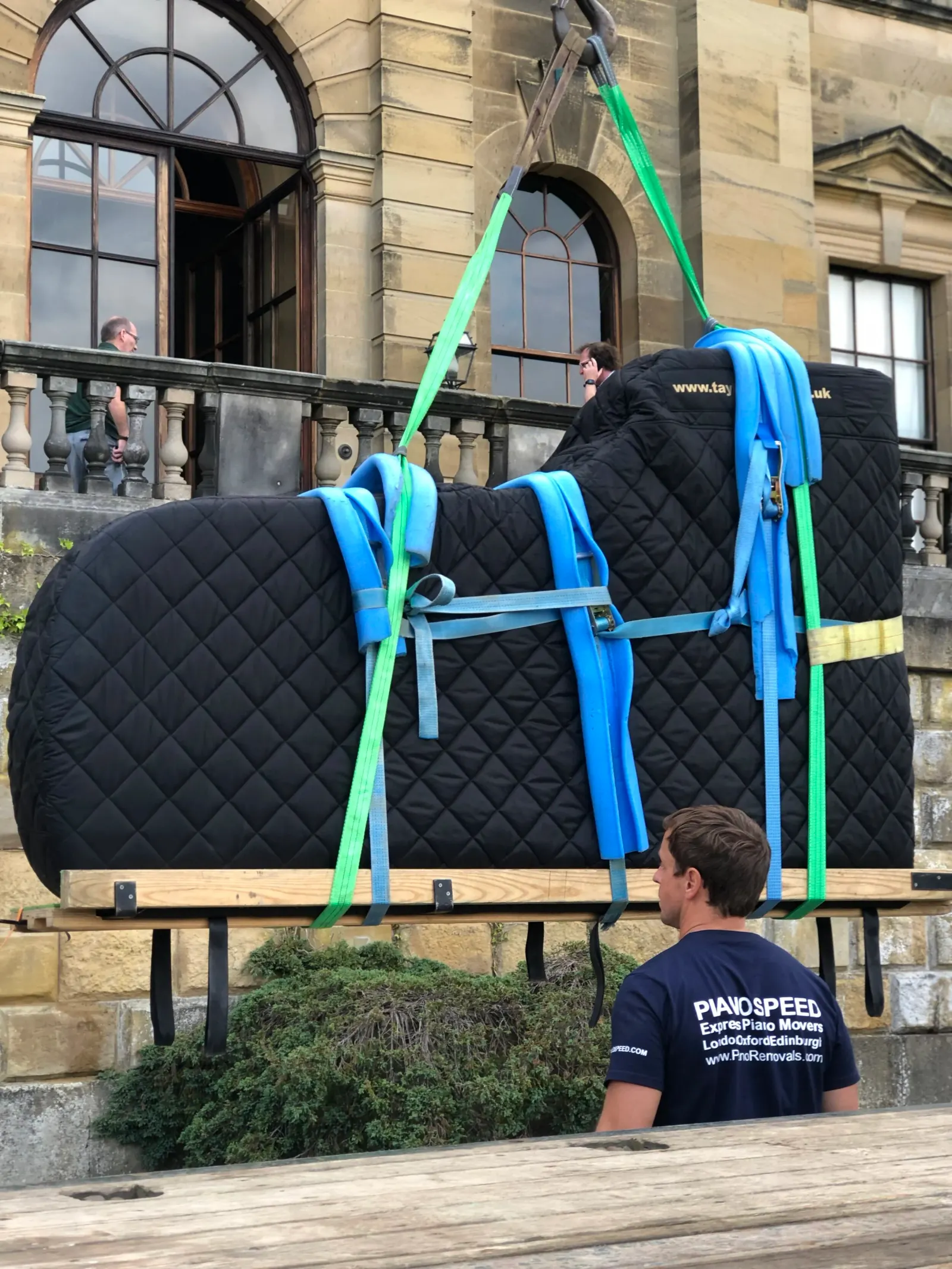
Collection from a stage or concert platform
Getting a concert grand off a stage is not the same as moving a piano out of a living room. The crew needs clear knowledge of the access route before they arrive: which entrance the piano goes out of, whether there are steps between the stage and the loading point, whether the instrument needs to come through the auditorium or can leave via backstage, and whether any fixed staging, orchestra pit covers or stage lifts are involved.
All of that information is taken at booking, not on the day. When you book the collection, you describe the access route, the floor the piano is on and any features of the stage or backstage area that affect how the crew will work. The specialist piano crew arrives prepared for the specific site, with the right equipment for the instrument and the access. If the piano is a large concert grand on a raised stage with steps to the loading bay, that is reflected in the price before you confirm.
Stair access between the stage and the exit is priced and confirmed at the time of booking. Nothing is added on the day of collection. If access is more complex than expected when the crew arrives, the job is not abandoned but any adjustment is handled transparently and agreed before the crew proceeds.
- Full access details taken at booking so the specialist crew arrives prepared for the specific stage and building
- Stage steps, pit covers, loading bay heights and backstage routes all factored in before you confirm
- Stair access priced in the booking and agreed before you proceed
- Part of the Pianospeed Group, with specialist experience moving concert-quality instruments across GB mainland and Belfast
- Large concert grands, baby grands and practice room uprights all collected using appropriate equipment for the instrument
Instrument pools across rehearsal rooms and practice suites
Most performing arts venues hold more than one piano. The concert grand on stage is the instrument audiences hear, but behind it sits a rehearsal room upright, a few practice room instruments and sometimes a piano in the green room or backstage warm-up space. When the building closes for a dark period or a substantial renovation, all of those instruments face the same risks as the stage piano, just with less attention paid to them.
Multiple pianos can be collected from one site in a single visit. Give the number and types at booking, along with their locations within the building, so the crew arrives with the right equipment and the job is organised efficiently. Rehearsal and practice room pianos tend to be cheaper to move individually, but they are also more likely to be left behind when attention goes to the headline instrument on stage. The condition they come back in after a long dark period is what the first students or musicians of the new season will find.
Return timing around the programming calendar
The return is booked separately, when the venue is ready to receive the piano. There is no fixed end date: the collection fee and the first four weeks are settled at booking, then a clear weekly rate continues for as long as the instrument needs to stay. If the dark period runs longer than expected, or the renovation overruns, the storage simply continues.
When the venue confirms the re-delivery date, the piano is prepared for return and delivered to the stage, rehearsal room or other location specified at the time of booking. The first tuning that follows a period of proper climate-controlled storage is a routine visit, not a pitch-raising exercise. That matters when the opening rehearsal of the season is two days after the piano goes back.
What the instrument receives in storage
The facility holds temperature and relative humidity at consistent levels year-round. The instrument is kept away from seasonal swings, dust and the unpredictable conditions of a building that is closed, part-occupied or under active works. Insurance covers the piano from the moment the specialist crew arrives at the venue until re-delivery is complete. The store is monitored around the clock.
Concert-quality instruments that return from a period of proper specialist storage typically need only a single tuning before they are ready to perform. That is the same number of tunings any piano needs after being moved, but from a measurably better baseline. Venues that have been through a refurbishment cycle with an instrument left on stage know the alternative.
Can you collect a concert grand from a stage?
Yes. We collect concert grands and other instruments from stages across GB mainland and Belfast. Give us the access details at booking: the exit route from the stage, whether there are steps between the platform and the loading point, any backstage features that affect access, and whether there is a piano lift or trap involved. The specialist crew arrives prepared for the specific site.
The piano is on a stage lift. Does that affect the collection?
Describe it at booking. A stage lift or pit trap changes how the crew approaches the collection, but it does not make it impossible. Tell us the lift dimensions, whether it can be raised to stage level for the collection, and what the access route looks like once the piano is at floor level. The crew will work with the building's stage management team where needed.
The venue has a concert grand on stage, two rehearsal room uprights and four practice room pianos. Can all of them be collected?
Yes. Give the number, types and locations of all instruments at the time of booking so the crew arrives with the right equipment and the job is planned correctly. Multiple pianos from one site are collected in a single visit where possible.
How is stair access charged?
Stair access is priced per flight and is confirmed in the online booking before you proceed. If the piano is on a raised stage, in a gallery rehearsal room or requires navigation of internal steps at any point along the access route, give those details when you book. Nothing is added on the collection day.
How long can the piano stay in storage during the summer dark period?
There is no minimum or maximum term. The collection fee and the first four weeks are settled at booking, then a clear weekly rate continues for as long as the piano needs to remain in storage. If the dark period or renovation runs over the expected end date, the storage simply continues. You book the return when the venue is ready.
Is a high-value concert grand insured in storage?
Yes. Full insurance covers the piano from the moment the specialist crew arrives at the venue, throughout the storage period and until re-delivery is complete. The store is monitored around the clock. If the instrument has a declared replacement value above the standard cover, discuss that at the time of booking.
Can the return be timed to arrive the day before the first rehearsal of the season?
You book the re-delivery date when the building is ready. Give us the date you need the piano back and we work backwards to prepare and schedule the delivery. A tuning appointment will be needed after re-delivery, as with any moved piano. The piano returns in the same condition it went in, so the tuning from that stable baseline is a straightforward single visit.
Store your piano the right way
We collect, protect and re-deliver. You only pay for the time you use.
Get an instant price★★★★★ Rated 4.9 out of 5 on Trustpilot from 77 reviews