Guides · 10 August 2026
Storing a Piano from a Walk-Up Flat with No Lift
A piano that arrived in a flat with no lift was almost certainly brought up by a specialist crew who knew exactly what they were doing. Getting it down again is the same job in reverse, and it carries the same requirements: trained people, the right equipment and a method that accounts for the weight, the dimensions and the particular geometry of a piano on a staircase.
The access information you give when you book is the starting point for everything that follows. The crew does not improvise on arrival. They have already decided on the method, the equipment and the team size based on what you described.
Why staircases need a specialist approach
A piano on a staircase is a specific physical problem. The weight is uneven and shifts as the angle changes. The case is rigid, with no flex, and it cannot be turned freely in a confined space. An upright on a single straight flight with clear headroom is a manageable carry for a prepared crew. An upright on a winding Victorian staircase, with a half-landing, a low ceiling and a tight turn at the bottom, needs to be planned carefully before the crew arrives.
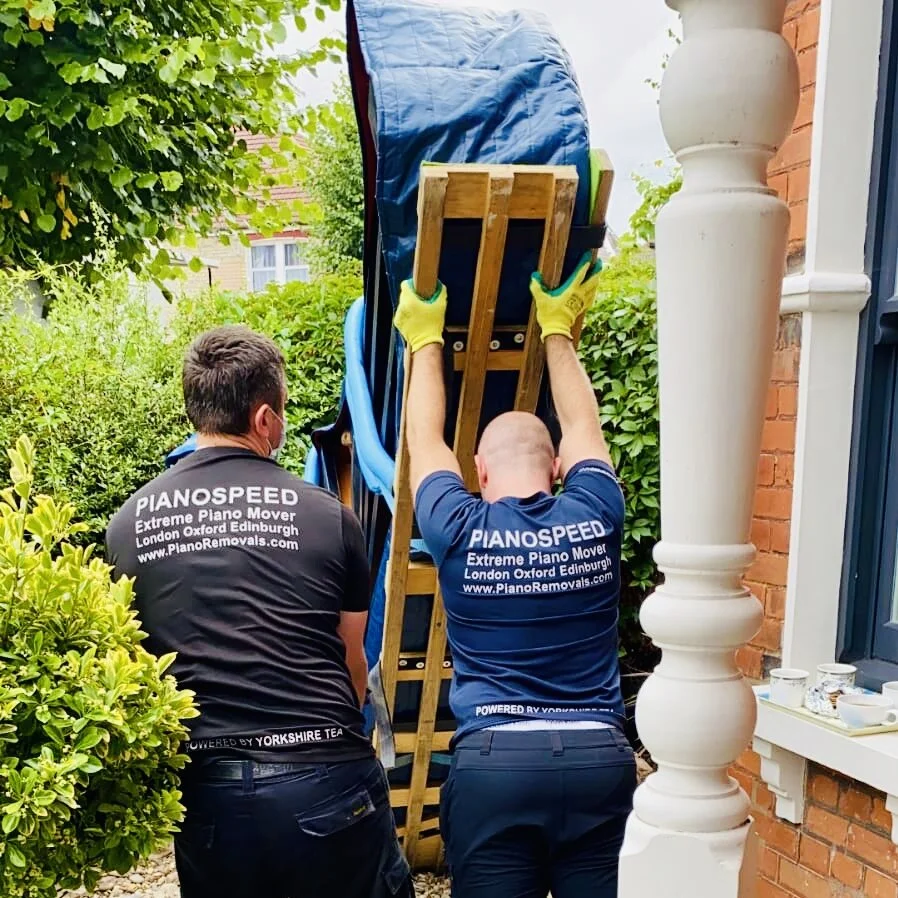
Specialist piano crews use equipment designed for stair work: purpose-built stair-climbing trolleys, strapping configurations that keep the instrument under control at every step, and a clear method for communicating between the crew at each end of the carry. A piano that shifts suddenly on a staircase, or is knocked against a wall during a carry, can suffer damage to the case, the mechanism and the tuning that has been built up through months of regular servicing. PianoStorage is the storage arm of the Pianospeed Group, whose specialist crews work with instruments across the UK, from ground-floor front rooms to fifth-floor walk-ups, using the same approach and the same equipment at every level.
What to tell us when you book
The most important thing is the floor the piano is on, counted from street level. Not the floor as listed on the building intercom, but the actual number of stair flights from the pavement to your front door. If there is a step at the building entrance, a lobby flight before the main staircase or a split across two separate stair sections, count all of them.
Tell us about the character of the staircase. Is it straight or does it have a landing and a turn? Roughly how wide is it at its narrowest? Is there a half-landing with a tight corner that the piano needs to clear? A ceiling that slopes above the mid-landing, a low door frame at the flat entrance or a threshold step that will catch on a covered instrument are all worth mentioning. None of these are reasons we cannot collect. They are reasons the crew needs to know what they are preparing for.
- Floor the piano is on, counted from street level
- Number of stair flights, including lobby stairs and split levels
- Whether the staircase is straight or has turns and landings
- Approximate width at its narrowest point
- Any low ceilings, sloping soffits or tight doorways on the route
- Building access details: intercom, concierge, key safe arrangement
How stair access is priced
Stair access is charged per flight, and the charge appears clearly during the booking process before you confirm anything. There is no negotiation at the door on collection day and no figure you did not already agree to. You see the full cost and confirm it when you book.
The charge reflects what stair access genuinely requires: additional time, specific equipment and in most cases a larger crew than a ground-floor collection. If you are unsure of the exact flight count, give your best estimate at booking and note the uncertainty. The crew will confirm the count on arrival, and any adjustment will be handled directly.
Preparing for collection day
Clear the route before the crew arrives. That means the path from the piano's current position, through to the front door, down the full staircase and out to the street. Remove anything that could become a hazard or slow the carry: bags left on the stairs, bicycles in the hallway, coat hooks or picture frames at head height near tight turns. The crew will ask you to move anything else that needs to go on the day.
The piano is wrapped in its fitted transit covers inside the flat, in the room it is currently in, before it moves anywhere. The covering is applied first; the carry begins second. This protects the case surface throughout the descent and the journey to the climate-controlled storage facility. If there is a communal staircase shared with other residents, a brief word to neighbours the day before means no one is surprised by the crew and equipment on the landing.
When the piano comes back
Re-delivery works the same way. When you book the piano's return, the stair access at the destination address is quoted as part of the re-delivery cost. If you are returning to the same flat, the access situation is already known. If you have moved somewhere different, give the new address and the same access details and we will quote accordingly.
One thing worth planning for: if anything has changed at the property since collection, let us know when you book re-delivery. Scaffolding erected since the piano went into storage, a building entrance that now requires different access, or any change to the staircase itself all affect how the crew approaches the job. A brief note at booking means the crew arrives prepared rather than discovering the change on the day.
Can a piano always be collected from a flat with no lift?
In the great majority of cases, yes. Specialist piano crews handle multi-floor collections regularly and come equipped for stair work specifically. The key is giving us the full access picture when you book: the floor, the number of flights, the character of the staircase and any tight corners or low ceilings on the route. For very unusual access situations, we may ask for photographs in advance so the crew can plan accordingly.
How are stair charges calculated?
Stair access is priced per flight, with the charge shown clearly during the booking process. You see the full cost before you confirm. The charge reflects the additional time, equipment and crew that a multi-floor collection requires compared to a ground-floor one.
What if my staircase is very narrow or has tight turns?
Tell us at booking. A narrow staircase or a tight corner changes the approach the crew takes, the equipment they bring and sometimes the team size. For very confined access we may ask you to describe the staircase in more detail or share photographs. In most cases the carry is entirely manageable with the right planning.
Can a grand piano be collected from a flat with no lift?
A grand without its legs is considerably lower and more manoeuvrable than an assembled instrument. For access that is genuinely very tight we assess each situation individually. The starting point is giving us the access details and letting us advise on what is possible. Uprights from multi-floor flats without lifts are straightforward for a specialist crew.
Do I need to be present when the crew arrives?
You or someone you authorise needs to be at the property to give access. That can be a family member, a letting agent, a building concierge or anyone with a key and the authority to let the crew in. Tell us who will be there when you book and we confirm the three-hour collection window with them directly.
How far in advance should I book a collection from a flat?
Each postcode area has one set weekly collection day. Booking a week or two ahead gives the most flexibility over which date suits you. Stair access does not require any special lead time, but having the booking confirmed in advance means the crew arrives fully prepared for exactly what is at your property.
Store your piano the right way
We collect, protect and re-deliver. You only pay for the time you use.
Get an instant price★★★★★ Rated 4.9 out of 5 on Trustpilot from 77 reviews