Guides · 15 August 2026
Baby grand vs upright: why storage costs differ between the two types
If you are comparing the storage cost for a baby grand against an upright, the underlying reason for any difference is not arbitrary. It follows directly from what each instrument requires at every stage of the process: collection, storage in the facility, and re-delivery. The upright is simpler in almost every respect. The baby grand demands more at each stage, and the quote reflects that.
Collection: why a baby grand is a more involved job
An upright piano goes into storage largely as it stands. The specialist crew wraps it in fitted transit covers, protects the keys and pedal area, and loads the instrument. Nothing is dismantled. For a standard domestic upright on a ground floor with reasonable access, this is a contained job that proceeds in a predictable way.
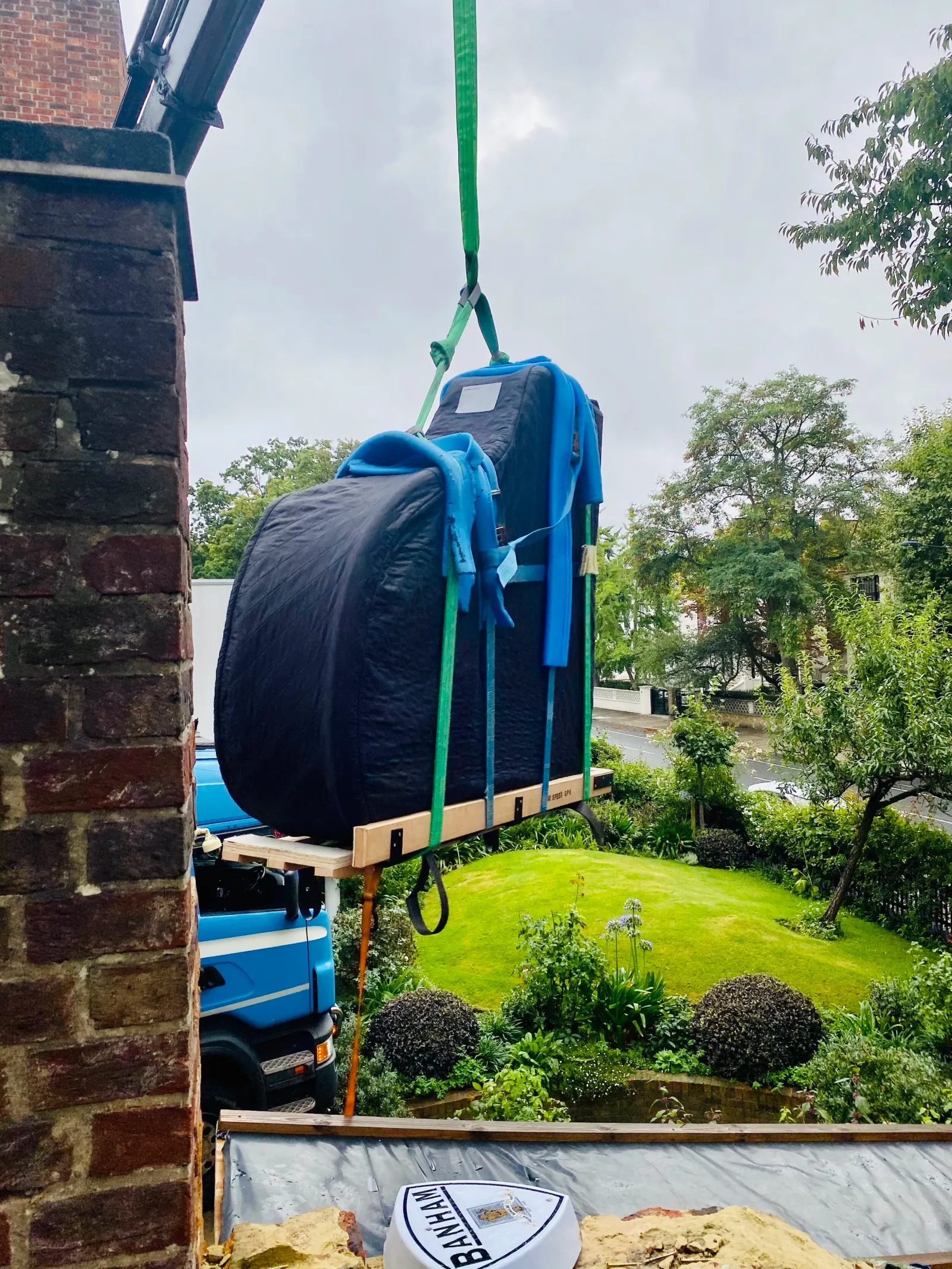
A baby grand is different from the first moment the crew arrives. Before the instrument can be moved at all, several parts need to come off. The lid and music desk are removed and wrapped so the polished surfaces cannot be damaged in transit. The legs are unbolted one at a time while the body is lowered and steadied onto a padded board. The lyre assembly, which carries the pedals, is detached and stored separately. Each removed part is labelled and kept alongside the instrument throughout.
That dismantling takes more crew time, requires additional wrapping materials and specialist equipment, and puts more demands on the team carrying out the job. The collection fee for a baby grand is higher than for an upright because the work involved is genuinely greater.
- Upright collection: wrapped in covers, protected at keys and pedal area, loaded as one piece
- Baby grand collection: lid, music desk, legs and lyre removed, each part wrapped and labelled, body lowered to a padded board
- The dismantling process requires additional crew time and specialist equipment
- Both types are collected by a specialist piano crew, not a general household team
Storage in the facility: floor space and the weekly rate
In the facility, an upright stands wrapped and secured in the same orientation it occupies in a room. A baby grand rests on its side on a padded board, with the flat underside facing outward. That is the correct position: the weight stays off the leg joints for the duration of the stay, the body is stable, and the floor area required is considerably less than a standing grand would need.
Less, but still more than a wrapped upright. A baby grand on its side takes up more floor area than a standard upright, and the weekly storage rate reflects that difference.
The climate control requirements are the same for both types. Temperature and humidity are held steady throughout the year in the facility, because both the upright and the baby grand are built from materials that are sensitive to seasonal change: the soundboard, the action components and the tuning pins all respond to shifts in humidity and temperature. Controlling those conditions is not optional for either type. The difference in the weekly rate is a matter of floor space, not of different levels of care.
The weekly rate covers more than floor space. It covers the conditions, the monitoring, the insurance and the security. The reason it differs between types is that a baby grand in the facility takes up more room than an upright, and nothing more complicated than that.PianoStorage
Stairs: chargeable for both types, but not equally
Stair access is charged at collection and at re-delivery for any piano, and both types are clear on that point in the booking. Carrying a piano up or down a staircase is skilled, physical work, and the charge is set from the access details you provide: the floor the piano is on and whether a suitable lift is available. Nothing is added on the day of collection.
For an upright on an upper floor, the instrument goes up or down in one piece. That is demanding, but the job is predictable once the floor and access details are confirmed.
For a baby grand on an upper floor, the situation is more involved. The body has already been dismantled before it can be moved, so the crew is working with the padded board, the body, and the separate parts through a confined stairwell. A baby grand on an upper floor typically needs a larger specialist crew than an equivalent upright would, and that is reflected in the stair charge. For a baby grand in a ground-floor room with good access, the access component is more straightforward. The floor the instrument is on makes a significant difference to this element of the booking for both types.
- Stair access is charged at collection and re-delivery for any piano type
- The charge is set in the booking from the access details provided, not added on the day
- A baby grand on an upper floor typically requires a larger specialist crew
- An upright on an upper floor is carried in one piece; a baby grand requires the body and parts to be navigated through the stairwell separately
- Confirming the floor and access details accurately when booking ensures the right crew and equipment arrive
Re-delivery: reassembly for a baby grand, placement for an upright
When an upright comes back from storage, the crew places it in position in the room, the protective covers come off, and the instrument is set where you want it. The job is broadly the collection run in reverse, and for an upright it is equally contained.
A baby grand re-delivery includes reassembly. The crew carries the body into position, re-attaches the legs one at a time while the body rests on the padded board, refits the lyre assembly and replaces the lid and music desk. The piano is then levelled before the crew leaves the room. This process is not complicated when you know the instrument, but it takes more time than placing an upright, and that is reflected in the re-delivery fee.
If the re-delivery address is different from the original collection address, that is straightforward for both types. Give us the new address and access details when you arrange the return, and the booking is updated. Storage billing stops from the date you confirm the re-delivery, not the day the crew arrives.
Seeing the exact figures for your booking
The most direct way to compare the cost for each type is to run both quotes online. Enter your postcode and select upright, then repeat with baby grand. Both quotes show the same structure: a collection fee, a weekly storage rate and any access charges built in from the details you provide. Nothing is added later. If the piano is on an upper floor, enter that information at the time and the stair charge will appear in the quote before you confirm.
There is no minimum term for either type. Billing continues in four-weekly rolling cycles from the date the piano arrives at the facility. Whether the instrument needs to stay for six weeks or six months, the rate holds and the billing stops when you confirm the re-delivery date.
Tuning on return: both types need it
One cost that sits outside the storage quote but is worth planning for is tuning. Any piano moves in pitch after a journey and after settling into a room, regardless of how stable the storage conditions were. For a short stay, one tuning session after the instrument has settled is usually enough. For a longer stay, two visits a few weeks apart is the standard recommendation.
A baby grand that has been in storage for several months, having been dismantled and reassembled as part of the process, often benefits from two tunings regardless of the length of the stay. The first tuning brings the pitch back to standard. The second, a few weeks later, stabilises the strings once they have settled under tension in the room. Booking the second appointment when you arrange the first saves the back and forth later.
Why does a baby grand cost more to store than an upright?
Three main reasons. First, the collection involves dismantling: the lid, legs and lyre assembly come off before the instrument can be moved, which takes more crew time and specialist equipment. Second, a baby grand stored correctly on its side takes up more floor area in the facility than a wrapped upright does, so the weekly rate is higher. Third, re-delivery for a baby grand includes full reassembly, which adds time to the visit. All three differences are visible in the quote before you confirm.
Is the climate-controlled storage the same for both types?
Yes. Both an upright and a baby grand are held in the same climate-controlled facility with temperature and humidity managed actively throughout the year. The care given to the conditions is not tiered by instrument type. The difference in the weekly rate is a matter of floor space, not a difference in the standard of the environment.
Is stair access charged differently for a baby grand than for an upright?
Both types are charged for stair access at collection and re-delivery, and the charge appears in the booking before you confirm. For a baby grand on an upper floor, the crew size required is typically larger, because the dismantled body and parts need to be navigated through the stairwell separately. That crew difference is reflected in the stair charge. For an upright, the instrument goes up or down in one piece, which is a more predictable job.
What does re-delivery involve for each type?
For an upright, the crew places the instrument in the room and removes the protective covers. For a baby grand, re-delivery includes full reassembly: the legs are re-attached while the body is steadied on a padded board, the lyre is refitted and the lid and music desk are replaced. The piano is then levelled before the crew leaves.
Can I get an exact cost comparison for my two pianos?
Yes. Run both quotes online by entering your postcode and selecting each piano type. Both quotes show the full picture: collection fee, weekly storage rate and any access or stair charges from the details you provide. There is no minimum term for either type. The quote is instant and nothing is added later.
Does a baby grand need more tunings after storage than an upright?
Both types need at least one tuning after they come out of storage and settle into a room. A baby grand that has been in storage for several months, having gone through dismantling and reassembly, often benefits from two tunings a few weeks apart: the first to bring the pitch back, the second to stabilise the strings once they have settled under tension. One thorough tuning is usually enough for an upright after a shorter stay.
Where do you collect both types from?
Throughout GB mainland and Belfast. Each postcode area has a set collection day, and we confirm a three-hour target window the day before collection so the right crew and equipment arrive when expected.
Store your piano the right way
We collect, protect and re-deliver. You only pay for the time you use.
Get an instant price★★★★★ Rated 4.9 out of 5 on Trustpilot from 77 reviews