Guides · 11 September 2026
Piano Storage During a House Rewire or Damp Treatment | PianoStorage
A full house rewire tends to be underestimated until it is underway. Electricians lift floorboards in every room to run cables, drill through joists and ceiling plaster, and chase channels into walls for conduit and back-boxes. The disruption spreads through the whole property rather than being contained to a single room. Damp treatment, whether chemical injection into external walls or surface tanking, brings a different set of problems: plaster opened up and re-rendered, months of drying required, and often industrial dehumidifiers running throughout. A piano that is in the property while either of these jobs is running is in a more exposed position than it might look.
What a rewire does to a piano's surroundings
The characteristic features of a rewire are fine dust and sustained vibration across the whole building. Chasing cables into walls means angle grinding and chiselling through plaster and masonry. Lifting and relaying floorboards adds wood dust to the mix. SDS drills punching cable routes through joists produce vibration in the structural frequency range that travels through floors and walls to wherever the piano is standing. There is no room that is genuinely outside the vibration zone when a crew is working in a two-storey property.
The dust produced by a rewire is particularly fine. Plaster and masonry particles at this scale pass through covers and gaps in the piano case, settling into the action mechanism. The felt bushings that guide each key, the hammer felts, the cloth on the dampers: all of them can be compromised by particles that build up imperceptibly over the weeks a rewire takes. The result is a touch that is subtly changed, keys that develop inconsistent weight or response, and a mechanism that a tuner will note but cannot fully address on a standard visit.
Tuning is also affected. Structural vibration from drilling and hammering throughout the property works gradually into the tuning pins. The friction that holds each pin in the pinblock is a precise and fragile thing. Repeated vibration at the right frequencies, day after day over a multi-week rewire, loosens that grip in small increments. A piano that was in good tune before the electricians arrived will need more than a single tuning session to recover afterwards.
Damp treatment: a humidity problem in two stages
Chemical injection damp-proofing requires drilling into external walls to inject a waterproofing cream, followed by rendering the affected surfaces with new plaster. That plaster contains a significant amount of moisture. A newly plastered wall releases water vapour into the surrounding air for weeks and sometimes months as it cures, pushing relative humidity in the property well above the 45 to 55 percent band that wood and felt are designed to tolerate.
Once the plaster is on, contractors typically run dehumidifiers and fan heaters to accelerate the drying. The same room that had high humidity during the wet plaster stage now runs at very low humidity as the equipment strips moisture from the air. For a piano in the same building, the effect is the soundboard, glue joints and action components being pushed toward high moisture content and then pulled sharply back toward low. That cycling is more damaging than either extreme held steadily, because wood responds to the change in both directions. Shrinking and swelling, repeated and alternated, is the mechanism that loosens glue, opens splits and stresses the bridge.
Why there is nowhere safe in the property
The instinct is to move the piano to the room that seems least affected and leave it there. On a rewire, that room does not exist. Cables have to reach every socket and light fitting in the property, which means every room eventually gets its floor lifted or its ceiling drilled. Even in rooms where the electricians finish quickly, the dust, the vibration and the open-building humidity are not contained. Air moves through a property and so does vibration through shared structure.
Damp treatment in a terrace or semi-detached property similarly affects walls on multiple sides of the house. The piano may be sitting against an internal wall that feels dry and removed from the work, but it is breathing the same air as the rooms where plaster is being applied and dehumidifiers are running.
For a project that is going to run for more than a few weeks, and both rewiring and damp treatment routinely do, removing the piano from the property before work starts is the cleaner decision. The instrument leaves in good condition and comes back when the property is finished, rather than spending the project accumulating damage that may not be fully repairable.
Arranging collection and return
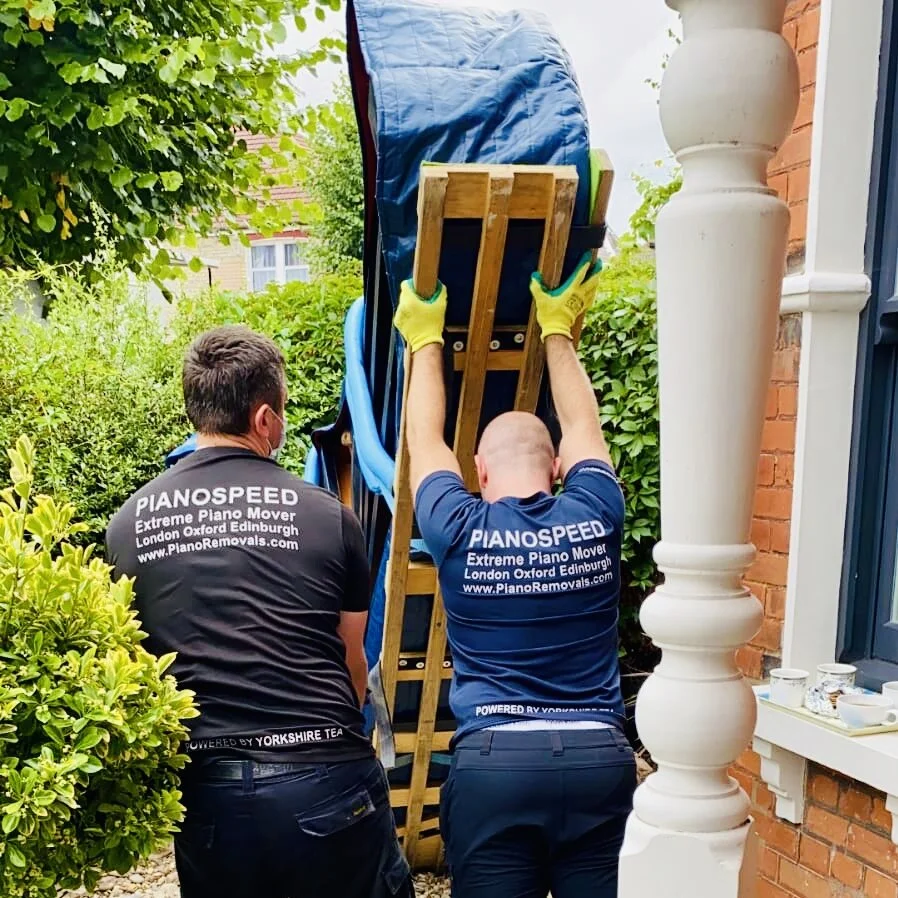
Specialist piano crews collect from your current address before the project starts. The piano is wrapped in fitted transit covers, moved in purpose-built vehicles with a liftgate and internal padding, and held in a climate-controlled facility at steady temperature and relative humidity throughout the project. It is not in a dusty, vibrating building. It is not breathing air that swings with a dehumidifier cycle. It is in the same conditions week after week until you are ready for it back.
The most straightforward time to book collection is a week or two before the electricians or damp contractors are due to arrive. Each postcode area has a scheduled collection day each week, so booking in advance secures the right slot. If work has already started and the piano is still in the property, we can still arrange collection: contact us with the postcode and access details and we will confirm the next available day.
- Climate-controlled facility holds temperature and humidity steady throughout the project
- Specialist piano crews collect and re-deliver, not a general removals team
- Full insurance from collection through to re-delivery
- No fixed term: storage runs for as long as the rewire or treatment requires
- Stair access is priced clearly in the booking so there are no surprises on the day
- Part of the Pianospeed Group, with crews experienced on all instrument types and sizes
When the property is finished, wait until new plaster has had a chance to dry properly before arranging re-delivery. Fresh render needs time to cure and stabilise humidity even after the visible drying is complete. A week or two of normal heating and ventilation after the work is genuinely done is a reasonable interval before booking the piano's return. Re-delivery goes to whatever address you choose, positioned where you want it, by the same specialist crew.
Does a house rewire really put a piano at risk if the piano is in a different room?
Yes, for two reasons. First, vibration from SDS drills and angle grinders travels through the building structure into every room, not just the one being worked on. Second, fine dust from plaster and masonry chasing moves through a property through open doorways, ventilation and air movement. A piano in a room where the electricians are not currently working is still affected by both.
How does damp treatment affect a piano if the piano is nowhere near the damp walls?
Damp treatment changes the humidity of the air throughout the property. New plaster releases moisture as it cures, raising relative humidity above the safe range for a piano. Dehumidifiers and drying equipment then strip that moisture back out. The piano responds to both directions of change, and the cycling is more damaging than either extreme held steadily. It does not need to be adjacent to the treated wall to be affected.
How long does a full house rewire typically take, and does that matter for storage?
A full rewire of an average-sized property typically takes between five and fourteen days of active work, though the overall project, including second-fix installation, certification and replastering, can extend to several weeks. From the piano's point of view it is the total period from when dust and vibration begin to when the last trades have finished that matters, not just the electrical work itself.
Can I arrange collection after the rewire has already started?
Yes. We can collect from a property where work is already underway. Give us the postcode, the access details and any note about how to reach the piano safely given the state of the site, and we will confirm the next available collection day for that area. The sooner it is collected, the less exposure the piano accumulates.
Does stair access affect the cost of collection from my property?
Stair access at the collection address is handled by specialist piano crews and is priced clearly in the booking. When you enquire, let us know what floor the piano is on, how many flights of stairs are involved and whether there is a lift. Any restricted access, a narrow hallway, scaffolding outside the front of the property, building materials blocking the route, should also be mentioned at the enquiry stage so we can assess it properly.
How long after damp treatment should I wait before re-delivery?
New plaster continues releasing moisture for several weeks after it looks dry. The safe approach is to wait until all remedial work is complete, the dehumidifiers have been removed and the property has had at least a week of normal central heating and ventilation at its finished state. Your contractor should be able to confirm when the plaster is fully cured. Re-delivery can be arranged for any date that suits you once the room is ready.
Store your piano the right way
We collect, protect and re-deliver. You only pay for the time you use.
Get an instant price★★★★★ Rated 4.9 out of 5 on Trustpilot from 77 reviews