Guides · 12 September 2026
Piano Storage Before a Loft Conversion or Extension | PianoStorage
Planning permission approved is usually when people start making practical decisions about the building work ahead. Rooms are measured up, routes through the house are worked out for materials, and scaffold positions are discussed with the contractors. The piano rarely gets serious attention at this stage. It is large, it is in the living room, and moving it feels complicated. But a loft conversion or house extension running for ten to fourteen weeks is a sustained period of structural work, and the piano is more exposed during it than most people realise.
What a loft conversion or extension involves structurally
A loft conversion is not comparable to a kitchen refit or a bathroom renovation in terms of what it does to a building. Converting a loft into a habitable room requires new steelwork to carry the new floor and redistribute roof loads, often with steel beams installed across the top of the existing walls. In a Velux conversion the original roof timbers are cut back and new joists are added between them. In a dormer conversion a section of roof is removed and rebuilt as a box structure. Either way, scaffold covers the property throughout, a crew is working in the building every day, and building materials move through the house from ground level upward over a period of eight to sixteen weeks.
A rear extension brings different structural demands: foundations are dug, external walls are built up or a steel frame is erected, the existing rear wall of the property is opened up and a new lintel is installed, and the whole space is then plasterboarded and finished. A full-width extension typically requires one or two weeks where the back of the house has no external wall at all, with only temporary hoarding and sheeting between the interior and outside air.
Three specific hazards for a piano during the build
The first is vibration. SDS drills, nail guns, angle grinders, circular saws and sledgehammers produce vibration in the frequency ranges that cause a building's structure to resonate. In a masonry property this is particularly effective: the vibration travels through concrete floors and brick walls to wherever the piano is standing, regardless of which floor it is on. The tuning pins in a piano hold each string at pitch by friction. Sustained structural vibration, day after day over a ten to twelve week project, works those pins gradually. The piano will be flat by the end and may need more than a single standard tuning visit to recover.
The second is fine dust. A loft conversion generates several types of airborne particle at once. Cutting structural timbers with circular saws produces wood dust. Fitting mineral wool or rockwool insulation releases fibres. Plasterboarding and skimming produces gypsum particles. All of these are significantly finer than ordinary household dust and they travel through air movement throughout the building. A piano case is not sealed: particles enter through the gap between the keys and the key slip, through the space under the fallboard and along the edges of the case. Once inside, they settle into the action mechanism, packing into the felt bushings that guide each key and building up on the hammer felts. The consequence is a touch that gradually deteriorates and a mechanism that a tuner cannot restore on a standard visit.
The third is humidity and temperature variation. Scaffold over the roof reduces the property's insulation during the conversion. In an extension, the period when the rear wall is open and sheeted with only hoarding is a direct connection between the interior and outside air. A property that held a steady 18 to 21 degrees Celsius throughout the previous year will see wider swings during the build. A piano's soundboard, glue joints and action components are all moisture-responsive: they expand when humidity rises and contract when it falls. The cycling between the two, sustained over weeks, is the mechanism that opens glue joints, stresses bridges and loosens the tuning.
Why there is no safe room in the house during a conversion
The natural instinct is to move the piano to the room furthest from the work and leave it there. In a kitchen refit or a single-room renovation that can be reasonable. In a loft conversion it is not, for a straightforward reason: the structural work is above every room in the property. Vibration from the conversion does not stop at a floor boundary. The SDS drill at roof level puts the same vibration into the ground floor as it does into the room immediately below. Dust generated in the conversion space comes down through the building as the crew comes and goes each day.
A rear extension creates a similar problem. The rear rooms are immediately adjacent to the site. The dust, the vibration and the cold air from an open rear elevation affect the whole ground floor. Even the front living room, apparently removed from the work, shares the same air and the same structure. Moving the piano from the back room to the front delays exposure rather than preventing it.
Arranging collection before the contractors arrive
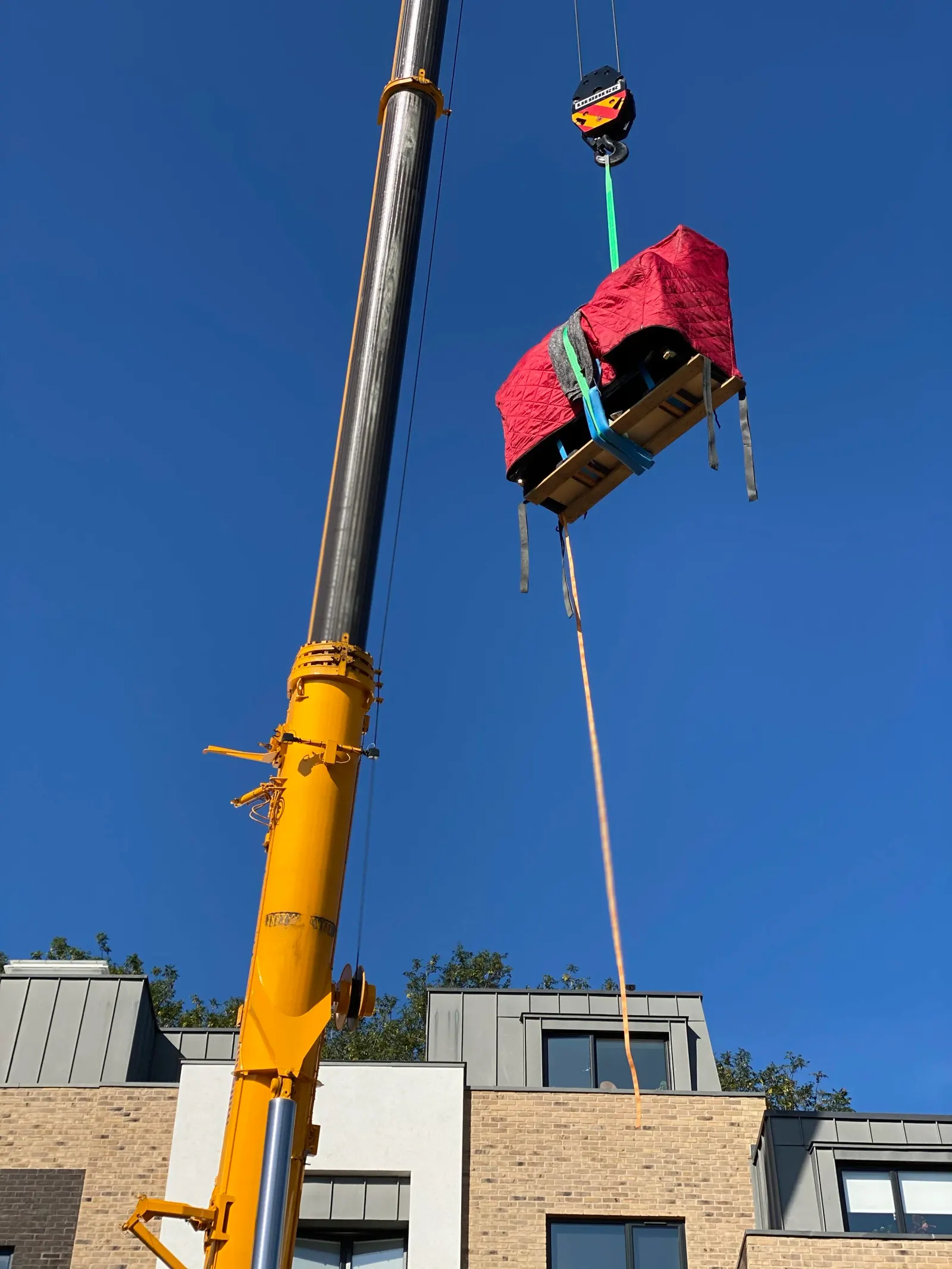
The straightforward approach is to arrange collection for the week before the contractors are due on site. A specialist piano crew wraps the instrument in fitted transit covers at the property, moves it in purpose-built vehicles to a climate-controlled facility, and holds it there in stable temperature and humidity for the full duration of the project. The facility maintains steady conditions regardless of what is happening at the property above. When the room is finished and the plaster has cured, the piano comes back to whatever address you choose.
Each postcode area has a scheduled collection day each week, so booking in advance secures the right slot. If work has already started and the piano is still in the house, collection can still be arranged: contact us with the postcode and access details and we will confirm the next available day for that area. The sooner it is collected, the less exposure it accumulates.
- Specialist piano crew wraps and collects the instrument before building work begins
- Climate-controlled facility holds temperature and humidity steady throughout the project
- Full insurance from collection through to re-delivery
- No fixed term: storage runs for as long as the conversion or extension requires
- Stair access at the collection address is priced clearly in the booking
- Part of the Pianospeed Group, with crews experienced on all instrument types and sizes
When you book, give us the full access details: what floor the piano is on, whether there is a lift, how many flights of stairs are involved, and whether scaffolding, a skip on the driveway or building materials are likely to affect access on collection day. Stair access is priced clearly in the booking so the full cost is settled before the crew arrives, with no surprises on the day.
Does a piano on the ground floor need to be stored during a loft conversion?
In most cases, yes. Structural vibration from conversion work travels through the building's floors and walls to wherever the piano is standing. The tuning pins are affected by sustained vibration over weeks, and fine dust from cutting, insulating and plastering travels down through the building with air movement. The ground floor is not outside the influence of work happening at roof level.
When is the right time to arrange collection before a loft conversion?
A week or two before the contractors are due on site is ideal. Each postcode area has a scheduled collection day each week, so booking in advance gives the best chance of slotting collection around your project start date. If scaffold is already up or work has started, collection can still be arranged: contact us with the postcode and access details and we will confirm the next available slot.
How is a loft conversion different from other building work as far as a piano is concerned?
The key difference is that the work runs above every room in the property at the same time. A kitchen renovation or bathroom refit affects a specific part of the house and there is somewhere genuinely removed from the dust and vibration. In a loft conversion the structural work is at roof level, and both the vibration and the airborne particles affect the whole building below it. There is no floor that is outside the influence of the build.
How long will my piano need to be in storage for a typical loft conversion?
Most loft conversions run between eight and sixteen weeks from first fix to snagging and final decoration. A ground-floor rear extension typically runs ten to twelve weeks. Add time at either end: collection should happen before the first contractors arrive, and re-delivery should wait until new plaster is cured and the room has been heated and ventilated for a week or two. Storage runs with no fixed term, so it stays for as long as the project requires.
Are stairs or access complications a problem for collection from my property?
Not a problem, but the details need to be in the booking. Let us know what floor the piano is on, how many flights of stairs are involved, whether there is a lift, and whether scaffolding, a skip or building materials are likely to affect access on collection day. Stair access is handled by specialist piano crews and priced clearly in the booking, so the full cost is agreed before the crew arrives.
How long after a loft conversion or extension is complete should I wait before re-delivery?
New plaster, including the skim coat and any remedial plastering, continues releasing moisture for several weeks after it looks dry. Waiting until all work is genuinely finished and the room has had at least a week of normal central heating and ventilation is a reliable approach. Your contractor can advise when the plaster is fully cured. Re-delivery can then be booked for whatever date and address suits you.
Store your piano the right way
We collect, protect and re-deliver. You only pay for the time you use.
Get an instant price★★★★★ Rated 4.9 out of 5 on Trustpilot from 77 reviews