Guides · 25 July 2026
How to store a Steinway or high-value piano safely
Some pianos are bought for the house. A Steinway is bought for life. The distinction matters when the instrument needs to go into storage, because the care required, and the consequences of getting it wrong, are not the same as for a decent upright in a house move.
What defines a high-value piano in storage terms
The category covers more instruments than people assume. Steinway grands of any model, Hamburg or New York, belong here. So do older Bechsteins and Bluthners, a full-size Bosendorfer, anything by Fazioli, and any piano with a meaningful specialist valuation whether or not the maker is well known. What they share in storage terms is this: precision hand-finishing, seasoned timber chosen and voiced to specific tolerances, and a long service life that depends on how the instrument is looked after between playing periods.
Storage raises the stakes for fine instruments in two ways. First, the cost of getting the conditions wrong is much higher. A crack in the soundboard of a common upright is a repair bill. The same damage in a Hamburg Steinway D is a different order of loss entirely. Second, these instruments are often worth considerably more than a standard home insurance policy covers, and that gap becomes visible when a claim is made.
Climate is not a single setting
Every piano needs stable temperature and humidity. For a fine instrument the requirement is more demanding, because the materials used in a high-value piano are often more precisely fitted and more responsive to small changes.
The target range is 45 to 55 percent relative humidity and 15 to 21 degrees Celsius. The word that matters is stable. A facility that averages 50 percent humidity on paper but swings between 35 and 65 percent across the seasons is not protecting a fine instrument. Steinway soundboards are cut from carefully selected Sitka spruce, with a crown built in under tension during manufacture. That crown responds to humidity changes before almost anything else in the piano. A garage in a wet autumn can push relative humidity well above 65 percent. A heated property in February can drop it below 30 percent. Either direction causes movement in a soundboard that was not built to flex in that way.
In a purpose-built climate-controlled facility, the conditions are held within a narrow band all year. There is no January drop when heating goes off overnight. There is no July spike in an unventilated space. The instrument that went in at 50 percent humidity is still sitting in 50 percent humidity six months later. For a fine grand, that consistency is the whole point of specialist storage.
The soundboard in a fine grand is not just a resonating panel. It is the acoustic core of the instrument, built under tension to specific crown tolerances. What it experiences in storage is what it retains.PianoStorage
Who collects and handles the instrument
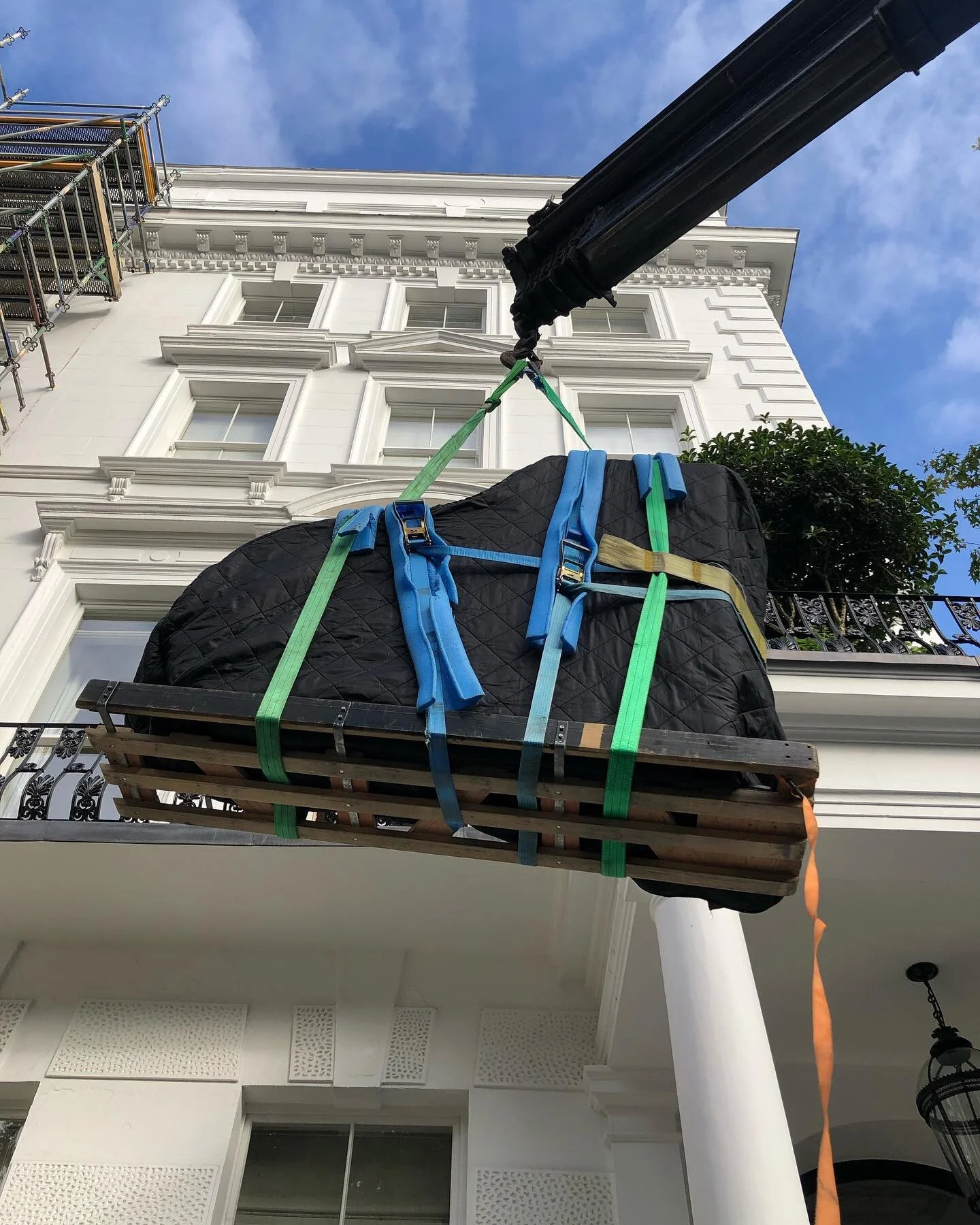
The collection of any piano, and particularly a valuable one, is not a job for a general team with a sack truck. A Steinway grand requires the same process as any other grand: legs removed one at a time while the body is steadied, the lyre assembly detached, the lid and music desk removed and wrapped separately, then the body lowered onto a padded board and wrapped with fitted transit covers. The crew doing this needs to know the instrument, not just the weight.
At PianoStorage the crews are trained piano specialists, part of the same Pianospeed Group that has handled concert instruments for institutions, musicians and private owners across GB mainland and Belfast. When we collect a Steinway, the process is exactly the same whether the piano is a Model S from the 1980s or a current concert instrument. The wrapping and handling are specified by the instrument, not the occasion.
- Legs removed one at a time while the body is steadied on a padded board
- Lyre assembly, lid and music desk stored separately and wrapped
- Fitted transit covers over the body for the full duration
- Specialist piano crews trained on grands of every size and age
- Secure, monitored facility with climate held within the target range all year
Valuation and insurance
A Steinway or fine grand in storage needs a valuation on file. When you book, tell us the instrument's make, model, age and serial number, and provide a specialist valuation if you have one. We log the piano against your account from collection to return, and the insurance that applies during storage can be aligned to your recorded valuation. Without a valuation on file, cover defaults to standard limits, which may not reflect what the instrument is worth.
Home insurance is worth checking carefully before assuming it covers a piano held elsewhere. Most policies cover instruments at the insured address. Cover at another site, whether a friend's property, a rehearsal space or a storage facility, is often excluded or capped. A specialist policy, or an explicit extension to an existing policy that covers the instrument in off-site storage, is the right approach. The time to establish this is before collection, not after.
Stairs, access and collection logistics
If the piano is on an upper floor, in a basement, or behind any access challenge, note this when you book. A Steinway Model B weighs around 210 kilograms before the legs come off. Moving it safely down a staircase demands the right crew size, the right equipment and a route agreed in advance. Stair access is priced clearly in the booking so there are no surprises on collection day.
You do not need to be at the property yourself. A family member, a trusted neighbour, a housekeeper or a solicitor's representative can give access on the day. We confirm the three-hour collection window directly with whoever is there.
Returning to form after storage
A piano that has been kept in genuinely stable conditions, whether for three months or three years, comes back in good shape. The pitch will drift slightly during the journey and while the instrument settles into a new room, so plan a tuning for two to three weeks after re-delivery rather than immediately. A piano that has been in storage for longer than a year may benefit from two tunings a few weeks apart to stabilise fully under tension.
Voicing, the adjustment of hammer felt to match your touch and tonal preferences, is sometimes needed after a long spell away. This is routine maintenance, not a sign that something went wrong in storage. The condition problems we see at re-delivery are almost always in instruments that were held in uncontrolled environments before coming to us. A piano that went into good storage in good condition should come out the same way.
Is specialist climate-controlled storage really necessary for a Steinway?
Yes, for anything longer than a few weeks. A Steinway soundboard is a precision-built component that responds to humidity and temperature changes before most other parts of the instrument. A garage, a heated room without humidity control, or a standard self-storage unit does not maintain stable enough conditions over months or years. Climate-controlled specialist piano storage is not a premium option for a fine instrument: it is the baseline.
Does the value of my piano affect the storage cost?
The collection fee and weekly storage rate are set by the type of instrument, not its monetary value. A Steinway grand is priced as a grand. What the value does affect is the insurance: provide a specialist valuation when you book and the cover can be aligned to that figure. Without a recorded valuation, standard limits apply and may not reflect what the instrument is worth.
How should a Steinway grand be positioned in storage?
On its side, on a padded board, with the legs stored separately and wrapped. The body is covered with fitted transit covers and held in a clean, stable facility. This is the correct position for any grand in storage. It protects the leg joints, reduces the floor footprint and keeps the action protected from impact.
Can I get a valuation done before my Steinway goes into storage?
Yes. A specialist piano valuer can visit the property before collection, or in some cases assess the instrument at the facility. Either way, provide the valuation reference when you book so it is logged against your account and can be used to calibrate your cover. Registered piano valuers can be found through the Incorporated Society of Musicians and specialist piano dealers.
Will a Steinway need voicing after coming out of storage?
Possibly, but voicing is routine maintenance, not an indication of damage. A piano kept in stable conditions should retain its full mechanical integrity. Voicing adjusts the hammer felt to your tonal and touch preferences and is a normal service interval item for any regularly used piano. Plan for tuning two to three weeks after re-delivery first, then a full service with your piano technician.
Are stairs or difficult access a problem for collection?
Not a problem, but it needs to be noted when you book. Tell us the floor the piano is on, whether there is a lift, the number of flights, and any tight turns or low ceilings in the stairwell. Stair access is priced clearly in the booking so the full cost is agreed before the crew arrives and there are no surprises on collection day.
Where do you collect Steinways and high-value pianos from?
Throughout GB mainland and Belfast. Each postcode area has a set collection day each week, and we confirm a three-hour window the day before so the right crew and equipment are ready when expected.
Store your piano the right way
We collect, protect and re-deliver. You only pay for the time you use.
Get an instant price★★★★★ Rated 4.9 out of 5 on Trustpilot from 77 reviews