Guides · 6 September 2026
How to Store a Steinway Baby Grand | PianoStorage
Steinway makes five sizes of concert grand. The baby grand, which includes the Model S at 155 centimetres and the Model M at 170 centimetres, is the smallest. It is also the instrument that owners most often misjudge when storage becomes necessary.
The misreading is understandable. A baby grand fits a sitting room, does not demand a concert hall acoustic, and is the most common Steinway size in private homes. Owners tend to think of it as the manageable one in the range. In storage, none of that applies.
The same construction, the same vulnerabilities
The term baby grand refers to external dimensions. The Steinway construction inside is unchanged. A Model S has the same hand-selected Sitka spruce soundboard under tension, the same hard rock maple rim laminated in layers around the rim, the same precision-fitted action with its repetition levers and hammer rest rails. These materials were chosen and fitted to exacting tolerances. That is what makes a Steinway sound like a Steinway, and it is also what makes storage conditions matter.
Every vulnerability of a full-size concert grand applies to the baby grand. The soundboard responds to humidity changes well before most other components. The pin block holds string tension against seasonal variation in the timber. The hammer felt shifts in texture and contact with temperature. A baby grand that goes into a cold, damp standard storage unit in October will come back in spring with measurable damage, whether or not anything is yet visible.
- Sitka spruce soundboard responds to humidity changes before most other parts of the instrument
- Pin block integrity depends on consistent temperature and humidity year-round
- Hammer felt accumulates particles in dusty or unprotected environments
- Cabinet and rim joints move in response to humidity cycling
- Climate requirements are the same for a 155cm Model S as for a 274cm Model D
How a baby grand is positioned in storage
Many owners assume that a baby grand, being smaller, is stored differently from a concert model. It is not. Any grand piano goes into storage on its side, on a padded board, with the legs removed before loading. The lyre assembly, lid and music desk come off separately, wrapped individually and loaded alongside the body.
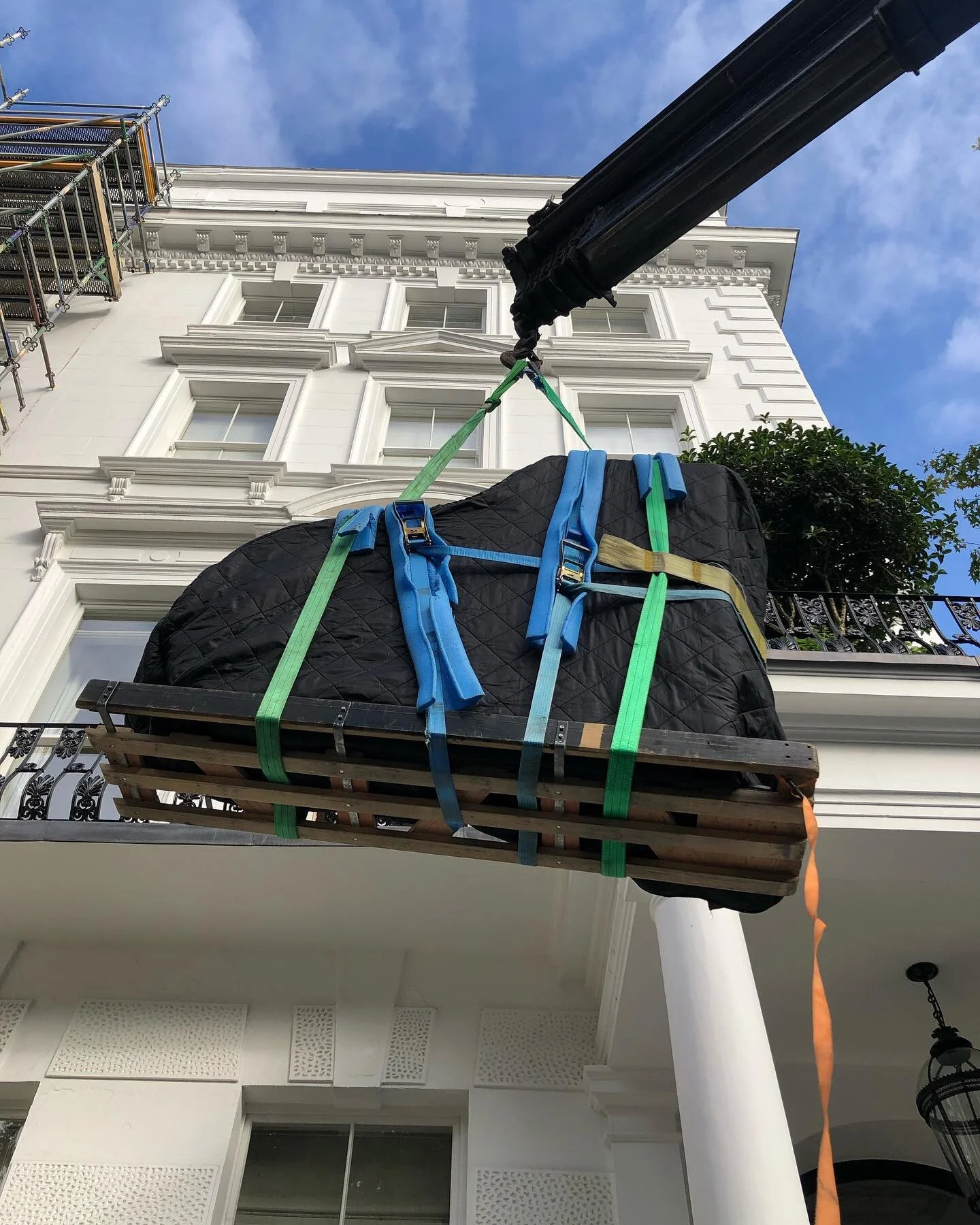
This is not a procedural preference; it is correct positioning for long-term storage. A grand left on its legs puts the joint between the leg and the cabinet under sustained load over months. It also increases the footprint and makes the instrument more vulnerable to being knocked. On its side, on a padded board, with a fitted transit cover over the body, the instrument is stable and protected. Specialist piano crews carry out this process at the point of collection, not at the facility, so the piano is correctly positioned from the moment it leaves the property.
What a standard self-storage unit does to a piano over months
A standard self-storage unit is an uncontrolled environment. Temperature follows the ambient season: single-figure temperatures in a British January, mid-thirties in a south-facing upper-floor unit in July. Relative humidity tracks the weather, often swinging between 30 and 80 percent across a year, depending on site and season.
A Steinway soundboard does not tolerate that range. The crown, which is the slight upward curve built into the soundboard under tension during manufacture, is held by the relationship between the soundboard and the cross-ribs beneath it. Humidity cycling compresses and releases that tension repeatedly. Over a single winter in an uncontrolled unit, that cycling does what years of normal playing would not: it fatigues the glue joints and shifts the tone of the strings in the upper register. A technician will find it before you hear it.
Dust is the second problem. A baby grand in a standard unit is often stored without adequate coverage. Piano actions accumulate particles that are not visible without removing the key slip, and by the time the piano is collected, the texture of the hammer felt has changed. A complete action clean after a dusty storage period is specialist work that could have been avoided entirely.
Booking, access and the collection process
When you book, give us the address, the floor the piano is on, and any access details relevant to the collection: a narrow hallway, a staircase between rooms, or a step at the entrance to the room. A Steinway baby grand weighs between 145 and 175 kilograms before the legs are removed, and a staircase changes what the crew needs in terms of numbers and equipment. Stair access is priced in the booking and confirmed before you proceed, so there are no additions on the day itself.
The collection window is three hours, confirmed the day before. You do not need to be present: a family member, a housekeeper or any person you authorise can give access. The piano leaves in a fitted transit cover, secured in a purpose-built vehicle, and goes directly to the climate-controlled facility. It is part of the Pianospeed Group, which has handled instruments for institutions, musicians and private owners across GB mainland and Belfast.
- Access details taken at booking so the specialist crew arrives fully prepared
- Stair access priced and confirmed before you proceed, no additions on collection day
- Legs, lyre, lid and music desk removed and wrapped at the property before loading
- Fitted transit covers on the body from the moment preparation begins
- Three-hour collection window confirmed the day before
- Any authorised adult can give access on your behalf
After storage: what the piano needs when it comes back
A baby grand that has been held in properly maintained climate-controlled storage comes back in good condition. The pitch will drift during the return journey and while the instrument settles in a new room, so plan a tuning two to three weeks after re-delivery rather than immediately, once the piano has had time to acclimatise. For instruments that have been in storage for more than a year, a second tuning a few weeks later helps the strings settle fully under tension.
Voicing, which is the adjustment of hammer felt to your tonal and touch preferences, may come up as a standard service item, particularly if the piano had not been serviced for some time before it went into storage. This is routine maintenance, not an indication of a problem during the storage period. A baby grand kept in stable conditions through its time away should come back in the same mechanical shape it left.
Is a Steinway baby grand as climate-sensitive as a larger concert grand?
Yes, in every material respect. The soundboard, pin block, hammer mechanism and cabinet in a Steinway Model S or M are built to exactly the same tolerances as those in a Model B or D. The internal construction does not scale down with the external dimensions. A baby grand responds to humidity and temperature variation in the same way as a full concert grand, and requires the same stable conditions in storage.
Can a Steinway baby grand go into a standard self-storage unit for a few months?
It is not a suitable environment. Standard self-storage units have no humidity control and no consistent temperature regulation. For a Steinway, which requires 45 to 55 percent relative humidity and stable temperature year-round, a standard unit means months of repeated humidity cycling. The soundboard crown is vulnerable to exactly this kind of stress, and the damage accumulates before it becomes audible. A climate-controlled specialist facility removes that risk entirely.
Do the legs need to come off a Steinway baby grand for storage?
Yes. Any grand piano, including the Model S and Model M, goes into storage on its side with the legs removed. Leaving a grand on its legs for months puts sustained load on the leg-to-cabinet joint and increases the instrument's vulnerability to being knocked. The specialist piano crew removes the legs, lyre assembly, lid and music desk at the property before loading, and stores each component wrapped separately.
How is a Steinway baby grand protected during the collection and while in storage?
The instrument is covered with fitted transit covers from the moment the specialist crew begins preparing it at your property. The legs, lyre assembly and music desk are wrapped separately and travel alongside the body. At the facility, the piano is held in a clean, climate-controlled environment with temperature and humidity monitored year-round. Insurance covers the instrument from collection to re-delivery.
The baby grand is on an upper floor. Can your crew manage that?
Yes. Stair access is routine for specialist piano crews. Give us the floor, the number of flights, any narrow landings and doorway widths when you book. Stair access is priced in the booking and confirmed before you proceed, so the full cost is agreed in advance and nothing is added when the crew arrives.
After storage, does a Steinway baby grand need anything different from a full-size grand?
The post-storage process is the same across grand sizes. Plan for a tuning two to three weeks after re-delivery, once the instrument has settled in its room at the local temperature and humidity. For pianos stored for more than a year, a second tuning a few weeks later helps the strings stabilise fully. Voicing and regulation, where they are due, can follow as standard maintenance at any point.
Store your piano the right way
We collect, protect and re-deliver. You only pay for the time you use.
Get an instant price★★★★★ Rated 4.9 out of 5 on Trustpilot from 77 reviews