Guides · 27 June 2026
Upright versus grand: how storage needs differ between the two types
When someone books piano storage, the first question is usually the same: how do we actually do it? For an upright the answer is relatively straightforward. For a grand, it is a more involved conversation. The two instruments share the same fundamental need for controlled conditions, but almost everything about how they are handled, positioned and protected across their time in storage is different.
What happens to an upright on collection day
An upright piano goes into storage broadly as it stands. The specialist crew wraps it in fitted transit covers, protects the keys and the pedal area, and loads it with the instrument remaining upright throughout. The internal structure of an upright is built around that orientation: the strings run vertically, the action sits on the front face, and the soundboard stands vertically behind the rear panel.
That vertical position is maintained throughout its time in the facility. Nothing is dismantled as a matter of course, though a loose or protruding music desk may be removed and wrapped separately, and the lid is secured. The piano is positioned firmly in the facility and nothing is placed on top of it or leant against it.
What happens to a grand on collection day
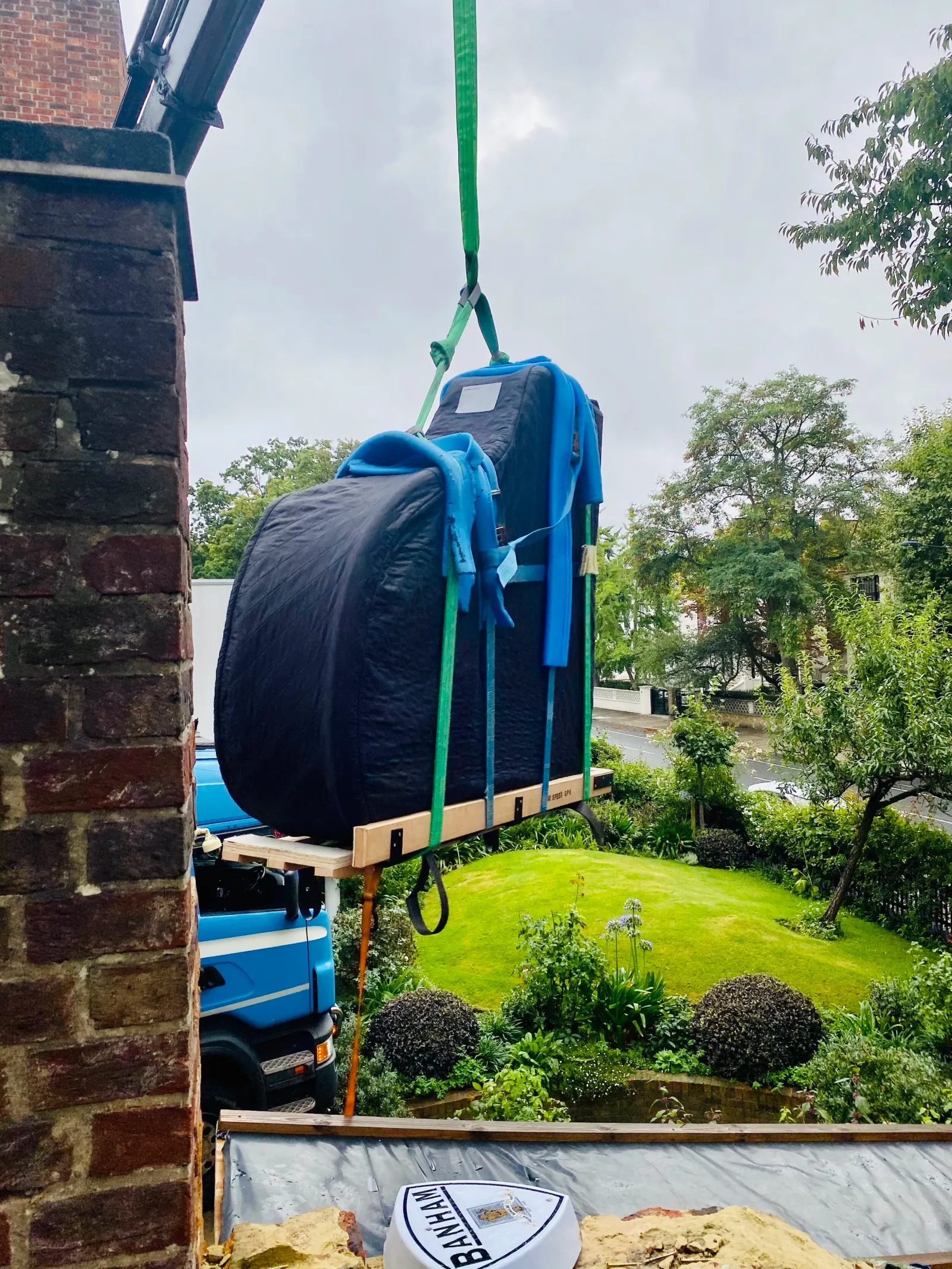
A grand is a different proposition from the moment the crew arrives. Before it can be moved safely, the lid and music desk come off and are wrapped to protect the polished surfaces. The legs are unbolted one at a time while the body is lowered and steadied onto a padded board. The lyre assembly, which carries the pedals, is then detached and held alongside the other parts.
In the facility, the body rests on its side on a padded board, with the flat underside facing outward. This is not a compromise. It is the correct position: the weight stays off the leg joints, the floor space required is far smaller than a standing grand would need, and the action and keys are protected in that orientation. Each removed component is wrapped, labelled and stored alongside the instrument.
On re-delivery day the process runs in reverse. The body is carried into position in the room, the legs are re-attached one at a time while the body is steadied on the board, the lyre is refitted, and the lid and music desk are replaced before the piano is levelled and the crew leaves.
Climate: the same requirement, different reasons
Both types of piano need climate-controlled storage. The reasons behind that need are not quite identical.
In an upright, the soundboard sits vertically inside the case, largely enclosed by the body of the instrument. It is still vulnerable to humidity changes, but the rear panel gives it some protection from direct air movement. The parts that tend to show signs of a poor storage environment first in an upright are the action components: the felt, the leathers and the wooden parts that make up the mechanical system.
In a grand, the soundboard is a much larger surface, slightly crowned, and in playing position it faces downward with its full area open to the air. When the body is stored on its side the exposure is different, but the climate requirement is the same: temperature and humidity held steady so that the soundboard neither dries out and cracks nor absorbs excess moisture and causes the bridges to lift.
Humidity is the bigger risk for both types, particularly across a UK year. The difference between a dry, centrally heated room in January and an unmanaged space in a damp August can be significant for wood under tension. A climate-controlled facility holds those conditions steady throughout. A garage, a spare room or a general self-store unit cannot offer that reliably across all four seasons.
The soundboard of any piano will, in time, tell you exactly how it was treated in storage. Controlled conditions are not a luxury; they are what keeps the wood honest.PianoStorage
Access and collection: why a grand takes more planning
The most common access consideration for any piano collection is stairs. Both types require specialist handling on a staircase, but a grand demands more preparation: the leg assembly needs space to come off before the body can be moved, the padded board requires a certain width through doorways, and the overall weight of a full-size grand calls for a larger specialist crew.
For a baby grand on a ground floor with clear access, the job is manageable with a standard specialist crew. For a larger grand on an upper floor, particularly in a property with a narrow Victorian staircase or low ceilings, the booking needs to cover every detail in advance: the floor the piano is on, whether there is a lift, the width of landings and doorways, and whether there are external steps at the front. Nothing should be left to discover on the day of collection.
- Confirm the floor and access route before booking, not on the morning of collection
- Stair access without a lift is costed separately and set out clearly in the booking
- A specialist piano crew, not a general removal team, handles both dismantling and any lifting through the building
- Tight corners, low ceilings and heavy front doors are all manageable with the right preparation and the right crew size
For an upright, access conversations are still necessary but shorter. The instrument stays in one piece, so the main questions are the floor it is on, whether stairs are involved, and whether any doorways are unusually narrow. Stair access for an upright is charged clearly in the booking in the same way as for a grand.
Tuning on return: both types need it, but grands need more
Neither type of piano comes back from storage ready to play without a tuning visit, and neither is an exception to this. Any piano will move in pitch after a journey and after settling into a new room environment.
For an upright that has been in storage for a matter of weeks, a single tuning once it has settled in the room is usually enough. For a longer stay, two visits spaced a few weeks apart will bring the pitch fully back to standard and let the strings stabilise.
A grand that has been in storage for several months, and has been dismantled and reassembled as part of the process, typically needs two tunings regardless of how stable the conditions were. The first visit brings the pitch back; the second, a few weeks later, stabilises the strings under that tension. Booking the second appointment when you arrange the first saves the back and forth.
Which type is more straightforward to store?
An upright is the simpler job in almost every respect. There is no dismantling, no reassembly, no separate parts to track through the booking and re-delivery. It takes less floor space in the facility, and the crew size required for a typical domestic upright collection is smaller. For a baby grand in a ground-floor room with good access, the gap in complexity is not enormous. For a larger grand on an upper floor with any access challenges, it is considerably wider.
What both types share is the same absolute requirement for specialist handling and controlled conditions. Neither should go into a general self-store unit. Neither should be moved by a team that handles only general household goods. Neither can be left in a room that is not actively heated and managed through the colder months. The difference between the two types is one of degree and method. The underlying requirement is the same.
Does an upright piano need to be dismantled for storage?
No. An upright goes into storage largely as it stands. It is wrapped in fitted transit covers, protected at the keys and pedal area, and stored upright. The music desk may be removed if it is loose, but the body of the instrument is not taken apart.
How is a grand piano positioned in the storage facility?
On its side, on a padded board, with the flat underside facing outward. The legs, lyre assembly, lid and music desk are removed during collection, wrapped separately and stored alongside. That position keeps weight off the leg joints and takes far less floor space than a standing grand would need.
Do both types of piano need climate-controlled storage?
Yes. Both a grand and an upright are made largely from wood, and both are at risk from humidity swings and temperature changes over a period of weeks or months. Climate-controlled storage holds temperature and humidity steady throughout the year. A garage, spare room or general self-store unit cannot do that reliably across a UK year.
Will my piano need tuning after it comes out of storage?
Yes, whatever the type. Any piano moves in pitch after a journey and after settling into a new room. An upright after a short stay usually needs one tuning once it has settled. A grand after several months in storage, having been dismantled and reassembled, typically needs two tunings a few weeks apart: one to bring it back to pitch, one to stabilise the strings under tension.
Does a grand piano take up more space in your facility than an upright?
Less than you might expect. A grand stored correctly on its side on a padded board takes up a compact footprint. A full-size grand standing on its legs would take up a considerable area, but that is not how it is stored. An upright is slightly more space-efficient still, but a grand stored on its side is not the space concern most people imagine.
What information do I need to give when booking collection of a grand?
The floor the piano is on, whether there is a lift, the approximate width of any landings and doorways, and whether there are external steps at the property entrance. Stair access without a lift is priced separately and clearly in the booking. For a larger grand on an upper floor, the crew size may need to be adjusted, so the access details need to be correct before the day.
Is stair access charged the same way for an upright as for a grand?
Both are charged for stair access without a lift, and the charge is set out clearly in the booking in each case. The rate for a grand may differ from that for an upright, reflecting the additional crew size and complexity involved in moving a larger, heavier instrument that has been dismantled.
Store your piano the right way
We collect, protect and re-deliver. You only pay for the time you use.
Get an instant price★★★★★ Rated 4.9 out of 5 on Trustpilot from 77 reviews