Guides · 26 June 2026
How specialists protect a piano from collection to storage
Handing a piano over to a crew you have not met before requires a degree of trust. An upright in good condition weighs somewhere between 180 and 260 kilograms; a grand is often more, and it is top-heavy and structurally complex. So what does a specialist crew actually do to protect the instrument? Here is a plain account of each stage, from the moment they arrive at the front door to the point where the piano settles into climate-controlled storage.
Before anything moves: the assessment
The first thing a specialist piano crew does on arrival is read the route. Doorway widths, the number of steps, the depth of each landing, whether the staircase runs straight or twists at the half-landing. None of this is a formality: a grand that is a few centimetres too wide for a doorframe needs a completely different approach from one with a clear, straight run to the street, and getting it wrong can damage the door frame, the plasterwork and the instrument.
This is also why access details are confirmed at booking, not discovered on the day. Stair access without a lift is priced clearly when you book, so the right crew and the right equipment arrive for the job that is actually in front of them. There are no improvised solutions.
Wrapping and preparing the instrument
The piano is wrapped before it leaves its position in the room. For an upright, that means fitted transit covers that hold snug around the full body of the instrument, protecting the top, the sides, the pedals and any decorative detail. The keyboard lid is fastened and cushioned before any tilt or movement. Removable parts such as the music desk and, on older instruments, candle brackets come off first and are bagged separately so nothing can work loose on the way.
A grand requires more preparation. The legs and the pedal lyre are removed, and each piece is wrapped individually and labelled. The lid is lowered, secured and covered. Once the legs are off, the case sits on a purpose-built board that distributes the weight evenly and allows it to roll safely across a flat floor. When the route involves a step or a tight corridor that rules out rolling, the crew lifts in stages, using the structural points of the instrument and not the outer case.
- Fitted transit covers protecting the full body before the instrument moves a centimetre
- Keyboard lid fastened and cushioned before any tilt or lift
- Removable parts taken off, wrapped individually and bagged
- Grand legs and pedal lyre removed, wrapped separately and stowed with the instrument
- Purpose-built board under a grand case once the legs are off, for controlled movement
Lifting the instrument without damaging it
Lifting a piano correctly is a question of mechanics and co-ordination. An upright moving down a single wide staircase is a different exercise from a grand being eased through a narrow hallway with a right-angle turn before the front door. Specialist crews train on these situations specifically, and the method is always about keeping the load stable, reducing the number of direction changes and keeping any single point of strain well within what the instrument can take.
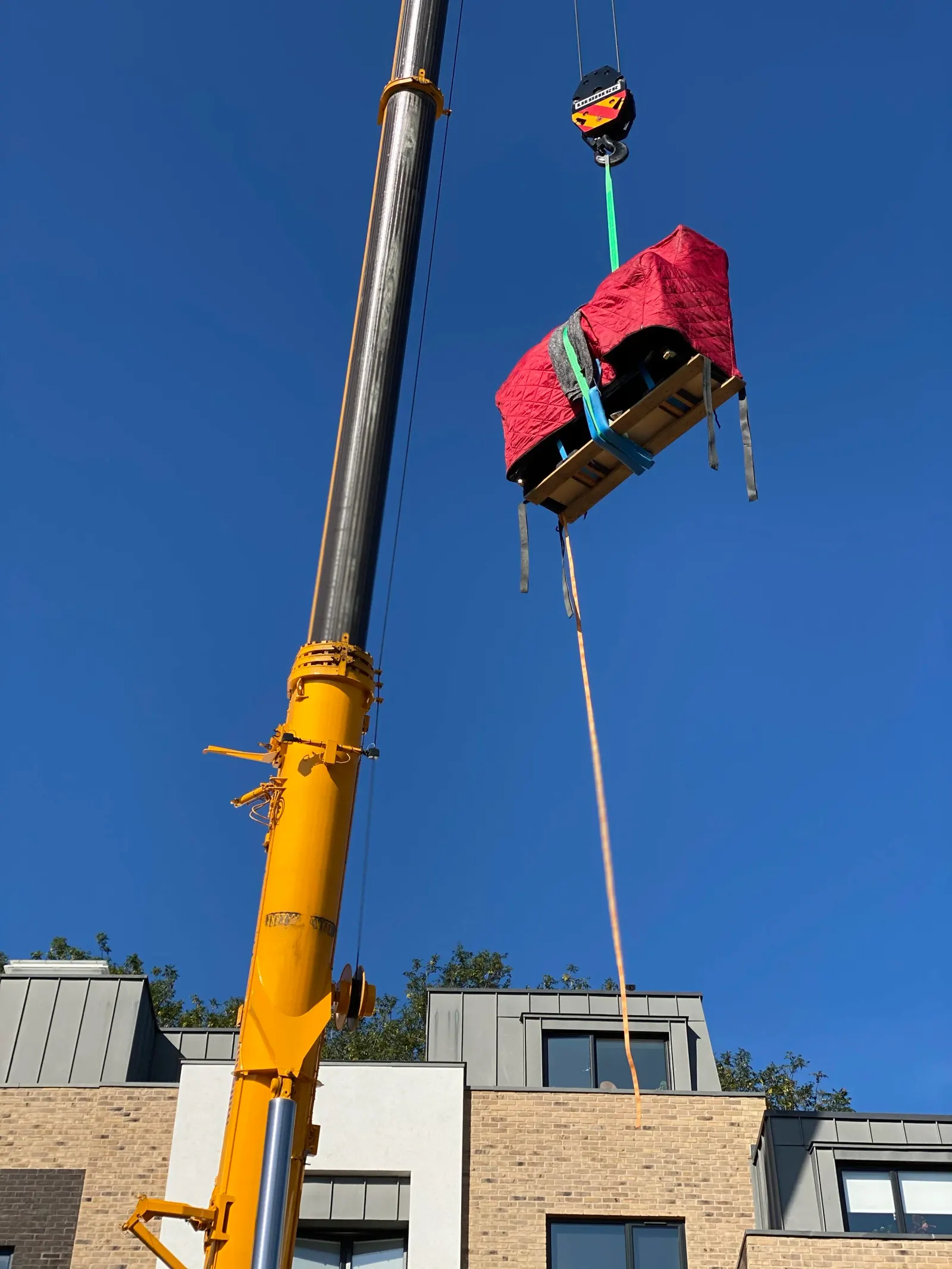
For upper-floor flats without a lift, a stair-climbing machine is often the right piece of equipment. It grips the instrument and walks it down or up the staircase with a controlled, even movement. In buildings where no safe internal route exists, a crane lift from a balcony or through an upper-floor window is sometimes the answer. This is planned in advance from the access details provided at booking, not worked out on the morning.
The journey to the storage facility
Purpose-built vehicles carry pianos differently from general-purpose lorries. The piano is secured with straps that hold it firmly without pressing on the case, and the interior of the vehicle is padded. An upright typically travels on its back rather than upright, because that position is more stable under braking and gives the instrument a lower centre of gravity. A grand stays on its purpose-built board with the case face-down and the legs secured alongside it.
The instrument is not left overnight in a vehicle. On arrival at the storage facility, the wrapping is removed enough for the piano to be checked against any pre-existing marks that were noted at collection, and it is then placed and logged against the booking.
In the climate-controlled facility
An upright piano is stored upright, on padded supports, not leaned against a wall or pushed against other stored items. A grand sits in a purpose-built cradle at the correct angle for the instrument's weight and case shape. Neither arrangement is casual: both are designed to protect the piano for a stay that could run from a few weeks to a year or more.
The storage environment holds temperature and humidity within a stable, narrow range throughout the year. There is no central heating cycle that cuts off overnight and no winter damp creeping in through an uninsulated roof. The piano is insured continuously from the moment the crew collects it to the day re-delivery is booked. Part of the Pianospeed Group, PianoStorage uses the same trained crews and the same standards whether the instrument is a basic upright or a concert Steinway.
How is a piano wrapped before collection?
The crew uses fitted transit covers that protect the full body of the instrument before it is moved. The keyboard lid is fastened and cushioned. On a grand, the legs and pedal lyre are removed first, wrapped individually and stowed alongside the case. Removable decorative parts such as the music desk are bagged separately so nothing shifts during the journey.
Does an upright piano travel upright in the vehicle?
No. An upright typically travels on its back, which gives a lower centre of gravity and is more stable under braking. This is standard practice for specialist piano crews and is designed to protect the instrument rather than just make loading convenient.
What happens if my piano is on an upper floor?
The crew brings the right equipment for the access you described at booking. On a standard staircase that means a stair-climbing machine. On a narrower staircase a full crew carry may be needed instead. Where no safe internal route exists, a crane lift from outside is sometimes the right answer. Stair access is priced clearly at booking so the crew arrives prepared.
Is the piano insured from the moment it is collected?
Yes. Insurance applies from collection, throughout the time in the climate-controlled storage facility, and until the piano is re-delivered. It is part of the service, not a separate policy you need to arrange yourself.
Do I need to prepare anything before the crew arrives?
Clear a path from the piano to the front door and remove loose items from on top and inside the lid. Make sure someone over 18 can give access during the confirmed collection window. The crew handles all the wrapping, protecting and lifting.
How is the piano stored once it arrives at the facility?
Uprights are stored upright on padded supports. Grands are held in purpose-built cradles at the correct angle. The facility maintains stable temperature and humidity all year. The piano is logged against your booking and held on full insurance for the full duration of the stay.
Store your piano the right way
We collect, protect and re-deliver. You only pay for the time you use.
Get an instant price★★★★★ Rated 4.9 out of 5 on Trustpilot from 77 reviews