Guides · 19 June 2026
Storing a grand piano: what is different and why it matters
People sometimes ask whether storing a grand is just the same job as storing an upright, only bigger. It is not. The differences begin before the crew touches the instrument, continue through every day it spends in the facility, and show up again on the day it is rebuilt in your room. Understanding those differences is useful whether you are putting a baby grand away during a renovation or looking after a full concert instrument for several years.
Dismantling: what comes off and why
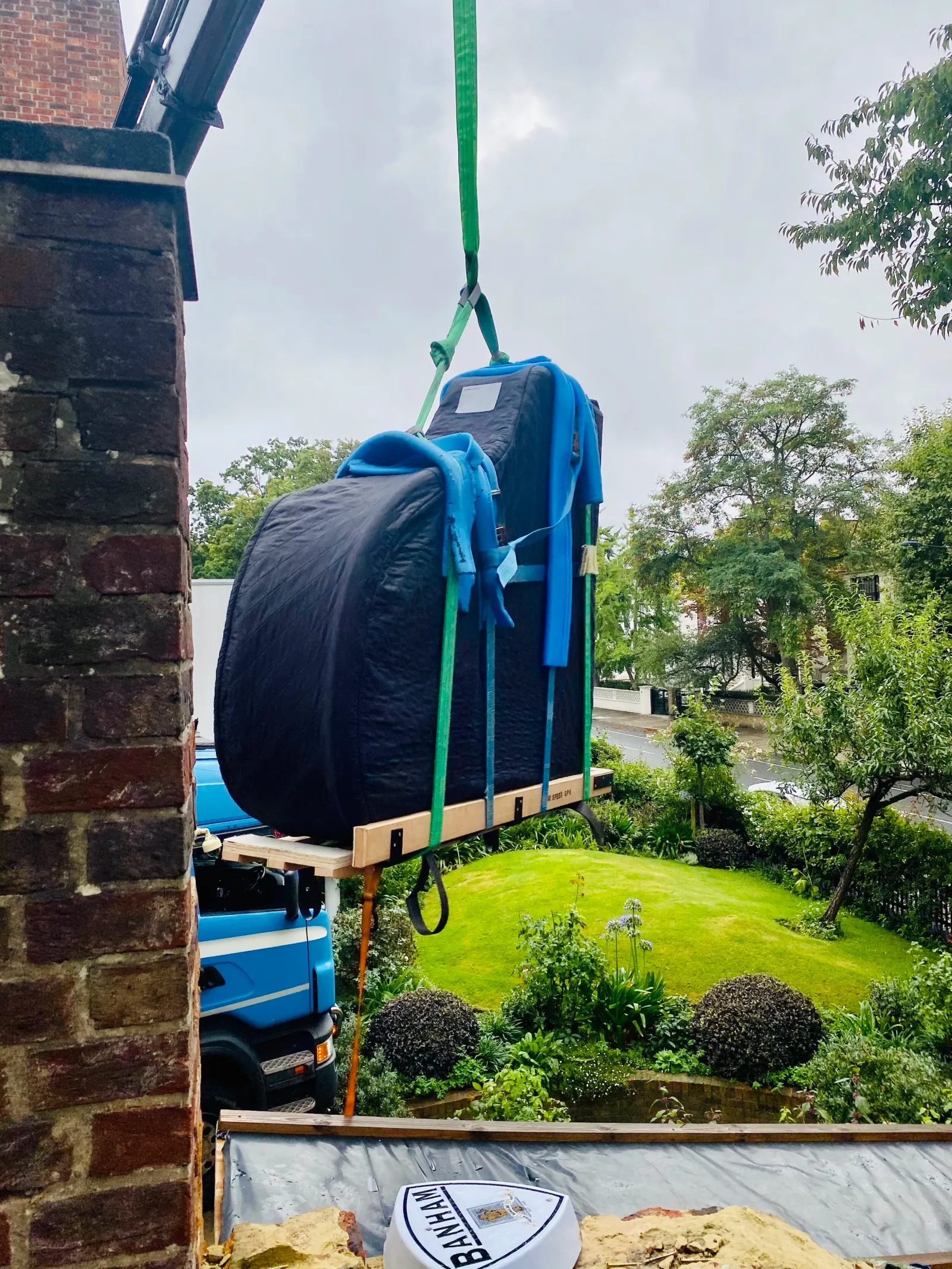
An upright goes into storage largely as it stands. A grand does not. Before a grand can be moved safely, several parts come off the instrument and are protected and stored separately. The lid and music desk are removed and wrapped so the polished surfaces cannot be scratched in transit. The legs are unbolted, one at a time, while the body is lowered and steadied onto a padded board. The lyre assembly, which carries the pedals, is detached and bagged. None of this is complex when you know the instrument, but every step requires the right tools, the right hands and an understanding of where a grand is vulnerable.
The reason it is done this way is structural as much as practical. A grand that is moved on its legs puts stress through points that were never designed to carry the instrument at an angle or on the move. Removing the legs and bringing the body down onto a board is safer for the instrument and for the crew.
How a grand sits in the facility
This is the detail that surprises most people. A grand in storage does not stand on its legs. The body rests on its side on a padded board, with the flat underside facing outward. The legs are stored alongside it, labelled and protected. That position is stable, requires far less floor area than a grand standing upright would, and keeps the weight off the leg joints for the duration of the stay.
The action, which is the mechanical heart of the piano, is protected from knocks in this position. Fitted covers go over the body and lid. Nothing is stacked on top of or against the instrument.
The soundboard: why it demands more attention in a grand
The soundboard in a grand is a large, tensioned sheet of spruce, slightly crowned, and it is what gives the instrument its voice. In an upright the soundboard is vertical and somewhat protected by the back of the case. In a grand it faces downward when the instrument is in playing position, and the full area of it is exposed to the air around it.
Humidity is the main risk. If the air around the soundboard dries out significantly, the wood shrinks and the crown can flatten or crack. If the air becomes too damp, the wood swells, the glue joints come under strain and the bridges can lift. Neither of these things happens gradually enough to catch early, and both are irreversible without significant repair.
In a purpose-built climate-controlled facility, temperature and humidity are held steady all year. The soundboard sits in conditions that do not change with the seasons. A garage, a school storeroom or an unmanaged self-store unit cannot offer that, and across a normal UK year it will not deliver it either.
The soundboard is what you are really paying to protect. Everything else about piano storage is secondary to keeping that sheet of spruce stable.PianoStorage
Access, stairs and the practicalities of collection
A baby grand in a ground-floor room is a manageable job for a specialist crew. A concert grand on the second floor of a Victorian house is a very different matter. The weight, the width of the body once the legs are removed, and the confined space of a domestic stairwell all create challenges that general removal teams are not equipped to handle.
When you book a grand collection, tell us about the access honestly: the floor the piano is on, whether there is a lift, any tight corners in the hallway, and whether there are steps outside the front door. Stair access is charged separately and clearly at the time of booking. There are no surprises on the day, but the right crew and kit need to be confirmed in advance.
- Confirm the floor and access route before booking, not on collection day
- Stair access is priced clearly in the booking and is not added afterwards
- A specialist piano crew, not a general removal team, handles the dismantling and lift
- Tight corners, low ceilings and heavy front doors are all manageable with the right preparation
Insurance and valuation for a grand
A fine grand, a Steinway, a Bechstein or a concert Yamaha, can be worth considerably more than a typical upright. Insurance that covers a standard piano may not reflect that valuation. When you book, tell us if you have a specialist valuation for the instrument. We log the piano against your booking from collection to return, and the full insurance cover that applies throughout the stay can be aligned to a recorded valuation if you provide one.
Insurance for a grand in a general self-store unit is your own responsibility. Many home contents policies exclude instruments held at a separate address, and finding a specialist policy that explicitly covers off-site storage is an added step many people overlook when they are comparing the two options.
Reassembly on return
Re-delivery for a grand is not simply the collection run in reverse. On the day the piano comes back, the crew carries the body into position, re-attaches the legs one at a time while the body is steadied on the board, refits the lyre assembly, and sets the lid and music desk back in place. The piano is levelled in the room before the crew leaves.
Once it is back in position, give it a week or two to settle into the room before you book a tuner. Any piano moves a little in pitch after a journey and a change of environment, and a grand that has been in storage for several months will almost certainly need two tunings spaced a few weeks apart to stabilise properly. That is expected, not a sign that anything went wrong.
Do the legs have to come off a grand piano for storage?
Yes. The legs are removed and the body is lowered onto a padded board before the piano is moved. It is safer for the instrument and the crew, and the body takes up far less space in the facility when stored correctly on its side. The legs are wrapped, labelled and stored alongside.
Can a grand piano be stored standing on its legs?
It can stand on its legs in a room, but storing it that way in a facility is not the correct approach. The legs are not designed to carry the full weight of the case and plate under movement or over a long period in a different environment. On its side on a padded board is the right position.
How is the soundboard protected during storage?
The main protection is the air around it. In a climate-controlled facility, temperature and humidity are held steady all year so the soundboard never dries out or becomes damp. Fitted covers protect the case. The soundboard itself is not accessible and does not need separate treatment, provided the conditions are right.
My grand is on the second floor with a narrow staircase. Can you still collect it?
Yes, in almost all cases. Tell us about the access when you book: the floor, any tight turns or low ceilings, whether there is a lift and whether there are steps outside. Stair access is charged separately and priced clearly in the booking. We confirm the crew size and equipment needed in advance.
Will my grand need tuning after it comes out of storage?
Yes. A tuning after re-delivery is normal for any piano after a move and a change of room. For a grand that has been in storage for several months, plan for two tunings spaced a few weeks apart: the first to bring the pitch back to standard, the second to stabilise the strings once they have settled under tension again.
Is a baby grand stored the same way as a full grand?
The process is essentially the same. The legs come off, the lyre is removed and the body rests on a padded board for the duration. A baby grand is lighter and shorter than a full grand, which makes collection and re-delivery a more straightforward job, but the same specialist approach applies.
Where do you collect grand pianos from?
Throughout GB mainland and Belfast. Each postcode area has a set collection day each week, and we confirm a three-hour target window the day before so the right crew and equipment arrive when expected.
Store your piano the right way
We collect, protect and re-deliver. You only pay for the time you use.
Get an instant price★★★★★ Rated 4.9 out of 5 on Trustpilot from 77 reviews